Slide 1 of 1 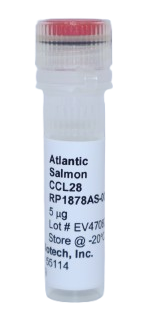
Atlantic Salmon CCL28 Recombinant Protein
- Catalog Number:
- RP1878AS
- Availability:
- In stock
- Application:
- Cell Culture, Control, ELISA, ELISpot Control, Western Blot Control
- 100% Homology:
- Salmo salar (Atlantic salmon)
 Powered by Bioz
 - Atlantic Salmon CCL28 (MEC, Mucosae-Associated Epithelial Chemokine) (catalog RP1878AS) is a yeast-derived chemokine supplied lyophilized without carrier protein in 10% trehalose; it has no affinity tags and is naturally endotoxin-free, and should be reconstituted in sterile PBS that contains at least 0.1% carrier protein. The protein is ~8.1 kDa, 71 amino acids long (full sequence provided), and >98% pure by SDS-PAGE, with 100% amino-acid homology to Atlantic salmon. Store at -20°C (stable up to twelve months from date of receipt; working aliquots with carrier protein stable ~3 months) and avoid repeated freeze/thaw cycles. Product origin is the USA. It is commonly used to study CCL28/MEC signaling and immune responses (including regulation of mucosal immunity, antimicrobial activity, and lymphocyte trafficking to epithelial tissues); typical experimental uses include cell-culture stimulation and migration assays, chemotaxis and signaling studies, ELISA and neutralization assays, flow-cytometry and Western blot controls, and antibody generation/validation. Kingfisher Biotech products are supplied for research applications and are not intended for medicinal, diagnostic, or therapeutic use.
| Amino Acid Sequence | GIPKCCVTTS MNIPTNVLRK VERAEMQRSN GVCDINALVL HVKGKKLCTH PKVKRKLKRM QRKKDGKPKR N (71) |
| Endotoxin | Naturally endotoxin-free |
| Form | Lyophilized |
| Storage Conditions | -20°C |
| Molecular Weight | 8.1 kDa |
| Purity | >98% as visualized by SDS-PAGE analysis. |
| Expression System | Yeast |
| Form | Lyophilized |
| Country Of Origin | USA |
Atlantic Salmon (Salmo salar) CCL28 (C-C motif chemokine ligand 28, also referred to as a mucosa-associated epithelial chemokine–like molecule in teleost fish) is a chemokine involved in regulation of mucosal immune responses and leukocyte recruitment in fish. Similar to mammalian CCL28, salmon CCL28-like signaling is associated with immune cell trafficking to mucosal tissues, helping coordinate immune defense at barrier surfaces. In Atlantic salmon, CCL28 expression is primarily detected in mucosal and epithelial tissues, including the gills, skin, and intestinal tract, which are key sites of pathogen entry in aquatic environments. The chemokine contributes to recruitment of lymphocytes, macrophages, and other immune cells to these tissues following pathogen exposure or inflammatory stimulation. Atlantic salmon CCL28-like activity is particularly relevant during infections caused by bacterial pathogens such as Aeromonas salmonicida and Vibrio species, as well as viral diseases like infectious salmon anemia virus (ISAV) and salmonid alphavirus, where mucosal immune responses are critical for early pathogen control. Proper regulation of CCL28-mediated immune cell trafficking supports pathogen clearance and maintenance of mucosal barrier immunity, while dysregulation may contribute to inflammatory tissue damage. As mucosal immunity is a major focus in aquaculture disease prevention, characterization of Atlantic salmon CCL28 supports research into host–pathogen interactions, mucosal vaccine development, and immune regulation in teleost fish, contributing to improved health management in salmon aquaculture.
Citations
Please choose a size to see price
RELATED MEDIA
