Slide 1 of 1 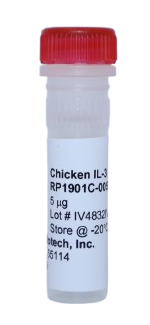
Chicken IL-3 Recombinant Protein
- Catalog Number:
- RP1901C
- Availability:
- In stock
- Application:
- Cell Culture, Control, ELISA, ELISpot Control, Western Blot Control
- 100% Homology:
- Gallus gallus (chicken), Gallus lafayettii (Ceylon junglefowl), Gallus sonneratii (gray junglefowl), Gallus varius (green junglefowl)
 Powered by Bioz
 - Chicken IL-3 (Interleukin-3) (catalog RP1901C) is a yeast-derived cytokine supplied lyophilized without carrier protein in 10% trehalose; it has no affinity tags and is naturally endotoxin-free, and should be reconstituted in sterile PBS that contains at least 0.1% carrier protein. The protein is ~13.9 kDa, 121 amino acids long (full sequence provided), and >98% pure by SDS-PAGE, with 100% amino-acid homology to chicken, Ceylon junglefowl, green junglefowl, and gray junglefowl. Store at -20°C (stable up to twelve months from date of receipt; working aliquots with carrier protein stable ~3 months) and avoid repeated freeze/thaw cycles. Product origin is the USA. It is commonly used to study IL-3 signaling and hematopoietic processes (including regulation of proliferation and differentiation of hematopoietic progenitor cells and immune cell development); typical experimental uses include cell-culture stimulation and proliferation assays, hematopoietic and cytokine signaling studies, ELISA and neutralization assays, flow-cytometry and Western blot controls, and antibody generation/validation. Kingfisher Biotech products are supplied for research applications and are not intended for medicinal, diagnostic, or therapeutic use.
| Amino Acid Sequence | SPLPLDKDCP STSSLSEVIE DVEKLQGSNE AIPPNNIILM MEQGEENAVT YLEEFIRALE SSKKQIKKDF LRNLQKIYST GKNCTGWLIH NWEPMESDDF FKNFEELLKF LNMYGVSKKT S (121) |
| Endotoxin | Naturally endotoxin-free |
| Form | Lyophilized |
| Storage Conditions | -20°C |
| Molecular Weight | 13.9 kDa |
| Purity | >98% as visualized by SDS-PAGE analysis. |
| Expression System | Yeast |
| Form | Lyophilized |
| Country Of Origin | USA |
Chicken interleukin-3 (IL-3) is a hematopoietic growth factor produced by activated T cells that supports the proliferation and differentiation of hematopoietic progenitor cells, contributing to the development of myeloid lineage cells through activation of JAK/STAT and related signaling pathways. In avian species, IL-3 plays a role in regulating immune cell expansion, including macrophages, heterophils, and other innate immune populations that are critical for early host defense. In poultry health, IL-3 is relevant to immune responses against economically significant pathogens such as avian influenza virus, Newcastle disease virus, Salmonella, and Eimeria species, influencing inflammatory responses, vaccine responsiveness, and recovery from infection. Proper regulation of IL-3–mediated hematopoiesis is important for maintaining immune competence without promoting excessive inflammation that could impair growth and production efficiency. Beyond agricultural applications, chicken IL-3 contributes to avian immunology research and serves as a valuable model for studying evolutionary aspects of cytokine signaling and hematopoietic regulation across vertebrate species.
Citations
Please choose a size to see price
RELATED MEDIA
