Slide 1 of 1 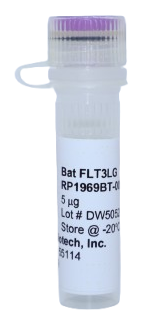
Jamaican Fruit-eating Bat FLT3 Ligand Recombinant Protein
- Catalog Number:
- RP1969BT
- Availability:
- In stock
- Application:
- Cell Culture, Control, ELISA, ELISpot Control, Western Blot Control
- 100% Homology:
- Artibeus jamaicensis (Jamaican fruit-eating bat)
 Powered by Bioz
 - Bat FLT3 Ligand (Fms-like Tyrosine Kinase 3 Ligand, FLT3LG) (catalog RP1969BT) is a yeast-derived cytokine supplied lyophilized without carrier protein in 10% trehalose; it has no affinity tags and is naturally endotoxin-free, and should be reconstituted in sterile PBS that contains at least 0.1% carrier protein. The protein is ~16.0 kDa, 142 amino acids long (full sequence provided), and >98% pure by SDS-PAGE, with 100% amino-acid homology to Jamaican fruit-eating bat. Store at -20°C (stable up to twelve months from date of receipt; working aliquots with carrier protein stable ~3 months) and avoid repeated freeze/thaw cycles. Product origin is the USA. It is commonly used to study FLT3 ligand signaling and immune/hematopoietic processes (including regulation of dendritic cell development, hematopoietic progenitor cell proliferation, and immune cell differentiation); typical experimental uses include cell-culture stimulation and proliferation assays, hematopoietic and cytokine signaling studies, ELISA and neutralization assays, flow-cytometry and Western blot controls, and antibody generation/validation. Kingfisher Biotech products are supplied for research applications and are not intended for medicinal, diagnostic, or therapeutic use.
| Amino Acid Sequence | RTPDCTFPHS PISSTFADTI RKLSDYLLED YPVTVATNLH DDKLCWAFWR LVLAQRCMER LKTVAGSQMQ QLLEDVNTEI YFVTSCALQD TSEQLVALKP WITRWNFSGC LELRCQPDSS TLLPSRSPKA LEATALPAAQ AP (142) |
| Endotoxin | Naturally endotoxin-free |
| Form | Lyophilized |
| Storage Conditions | -20°C |
| Molecular Weight | 16.0 kDa |
| Purity | >98% as visualized by SDS-PAGE analysis. |
| Expression System | Yeast |
| Form | Lyophilized |
| Country Of Origin | USA |
Jamaican Fruit-eating Bat FLT3 Ligand (FLT3L, also known as Fms-like tyrosine kinase 3 ligand) is a hematopoietic growth factor belonging to the cytokine family that regulates the development, proliferation, and survival of hematopoietic progenitor cells and dendritic cells. In the Jamaican fruit-eating bat (Artibeus jamaicensis), FLT3 ligand is produced by stromal cells, activated T cells, and other immune-associated cells, where it functions in the bone marrow and lymphoid tissues to support hematopoiesis and immune cell development. FLT3L binds to its receptor FLT3 (CD135) expressed on hematopoietic stem cells and early progenitor cells, activating intracellular signaling pathways such as STAT5, PI3K–AKT, and MAPK, which promote cell survival, proliferation, and differentiation, particularly of dendritic cell precursors and lymphoid progenitors. In bats, FLT3L likely plays an important role in maintaining innate and adaptive immune cell populations, including dendritic cells that are critical for antigen presentation and antiviral immune responses. Because bats are natural reservoirs for several zoonotic viruses, including coronaviruses and other emerging pathogens, studying immune regulators such as FLT3 ligand helps researchers understand hematopoietic and immune system regulation in bat species, contributing to research on host–pathogen interactions, immune tolerance, and comparative immunology in viral reservoir hosts.
Citations
Please choose a size to see price
RELATED MEDIA
