Slide 1 of 1 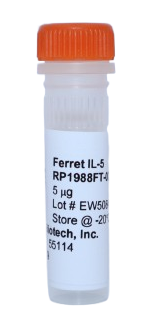
Ferret IL-5 Recombinant Protein
- Catalog Number:
- RP1988FT
- Availability:
- In stock
- Application:
- Cell Culture, Control, ELISA, ELISpot Control, Western Blot Control
- 100% Homology:
- Mustela lutreola (European mink), Mustela nigripes (black-footed ferret), Mustela putorius furo (domestic ferret)
 Powered by Bioz
 - Ferret IL-5 (Interleukin-5) (catalog RP1988FT) is a yeast-derived cytokine supplied lyophilized without carrier protein in 10% trehalose; it has no affinity tags and is naturally endotoxin-free, and should be reconstituted in sterile PBS that contains at least 0.1% carrier protein. The protein is ~13.1 kDa, 115 amino acids long (full sequence provided), and >98% pure by SDS-PAGE, with 100% amino-acid homology to domestic ferret, European mink, and black-footed ferret. Store at -20°C (stable up to twelve months from date of receipt; working aliquots with carrier protein stable ~3 months) and avoid repeated freeze/thaw cycles. Product origin is the USA. It is commonly used to study IL-5 signaling and immune responses (including regulation of eosinophil growth, differentiation, and activation, as well as roles in allergic inflammation); typical experimental uses include cell-culture stimulation and proliferation assays, cytokine signaling studies, ELISA and neutralization assays, flow-cytometry and Western blot controls, and antibody generation/validation. Kingfisher Biotech products are supplied for research applications and are not intended for medicinal, diagnostic, or therapeutic use.
| Amino Acid Sequence | TPVEDPMNRL VAETLTLLST HRTLLIGDGN LMIPTPENKN HQLCIEEVFQ GIDILKNRTA QAAAVDKLFQ NLSFIKAHID SQKKKCGGER WRVKKFLDYL QVFLGVINTE WTTES (115) |
| Endotoxin | Naturally endotoxin-free |
| Form | Lyophilized |
| Storage Conditions | -20°C |
| Molecular Weight | 13.1 kDa |
| Purity | >98% as visualized by SDS-PAGE analysis. |
| Expression System | Yeast |
| Form | Lyophilized |
| Country Of Origin | USA |
Ferret Interleukin-5 (IL-5) is a Th2-associated cytokine produced primarily by activated CD4⁺ T helper 2 (Th2) cells, mast cells, and group 2 innate lymphoid cells in ferrets (Mustela putorius furo), where it plays a central role in eosinophil differentiation, activation, recruitment, and survival. IL-5 belongs to the common beta chain (βc) cytokine family, which also includes IL-3 and granulocyte–macrophage colony-stimulating factor (GM-CSF); these cytokines share the βc receptor subunit and are involved in regulating hematopoiesis and myeloid cell function. IL-5 signals through a receptor complex composed of IL-5Rα and the shared βc chain, activating JAK/STAT and MAPK pathways that promote eosinophil maturation in the bone marrow and enhance their effector functions in peripheral tissues. In ferret health and research, IL-5 is relevant in models of allergic airway inflammation and respiratory viral infections, where Th2 polarization and eosinophilic responses may influence airway pathology, mucus production, and tissue remodeling. While IL-5 supports protective immunity against parasitic infections, excessive or prolonged IL-5 expression can contribute to eosinophilic inflammation and lung injury. Because ferrets are widely used as translational models for human respiratory disease and vaccine studies, characterization of ferret IL-5 supports investigations into Th1/Th2 immune balance, eosinophil biology, and development of targeted anti–IL-5 therapeutic strategies relevant to allergic and airway inflammatory disorders.
Citations
Please choose a size to see price
RELATED MEDIA
