Slide 1 of 1 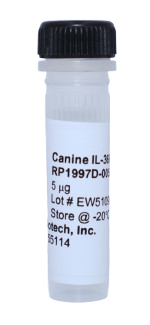
Canine IL-36 Receptor Antagonist (IL-36RA) Recombinant Protein
- Catalog Number:
- RP1997D
- Availability:
- In stock
- Application:
- Cell Culture, Control, ELISA, ELISpot Control, Western Blot Control
- 100% Homology:
- Canis lupus dingo (dingo), Canis lupus familiaris (dog), Vulpes lagopus (Arctic fox)
 Powered by Bioz
 - Canine IL-36RA (Interleukin-36 Receptor Antagonist) (catalog RP1997D) is a yeast-derived cytokine supplied lyophilized without carrier protein in 10% trehalose; it has no affinity tags and is naturally endotoxin-free, and should be reconstituted in sterile PBS that contains at least 0.1% carrier protein. The protein is ~16.9 kDa, 154 amino acids long (full sequence provided), and >98% pure by SDS-PAGE, with 100% amino-acid homology to dog, dingo, and Arctic fox. Store at -20°C (stable up to twelve months from date of receipt; working aliquots with carrier protein stable ~3 months) and avoid repeated freeze/thaw cycles. Product origin is the USA. It is commonly used to study IL-36RA signaling and immune responses (including inhibition of IL-36-mediated inflammatory pathways and regulation of epithelial and immune responses); typical experimental uses include cell-culture stimulation and cytokine modulation assays, signaling studies, ELISA and neutralization assays, flow-cytometry and Western blot controls, and antibody generation/validation. Kingfisher Biotech products are supplied for research applications and are not intended for medicinal, diagnostic, or therapeutic use.
| Amino Acid Sequence | VLSGALCFRM KDAALKVLYL HDNQLLAGGL HAGKVIKGEE ISVVPNRSLD AKLSPVILGV QGGSQCLSCG TGQEPTLKLE PVNIMELYLG AKESKSFTFY RRDTGLTSSF ESAAYPGWFL CTVPEADQPL RLTQLSEDAS WDNPITDFYF QQCD (154) |
| Endotoxin | Naturally endotoxin-free |
| Form | Lyophilized |
| Storage Conditions | -20°C |
| Molecular Weight | 16.9 kDa |
| Purity | >98% as visualized by SDS-PAGE analysis. |
| Expression System | Yeast |
| Form | Lyophilized |
| Country Of Origin | USA |
Canine Interleukin-36 Receptor Antagonist (IL-36Ra) is an anti-inflammatory cytokine that regulates IL-36–mediated immune responses in dogs (Canis lupus familiaris). IL-36Ra is a member of the IL-1 cytokine family and functions as a natural inhibitor of the IL-36 signaling pathway by binding to the IL-36 receptor (IL-36R, also known as IL1RL2) without activating it, thereby preventing proinflammatory cytokines such as IL-36α, IL-36β, and IL-36γ from initiating downstream signaling. Through this mechanism, canine IL-36Ra suppresses activation of intracellular pathways including NF-κB and MAPK, helping to limit production of inflammatory mediators and regulate immune responses at epithelial barrier tissues such as the skin and mucosal surfaces. In dogs, IL-36Ra contributes to maintaining immune homeostasis and controlling excessive inflammatory responses associated with infection, tissue injury, or allergic inflammation. In cell culture, recombinant canine IL-36Ra is commonly used to inhibit IL-36–induced inflammatory signaling in epithelial and immune cells, enabling investigation of cytokine regulation, epithelial–immune cell interactions, and inflammatory pathway modulation in vitro. Canine IL-36Ra is also relevant in translational veterinary research, particularly in studies of inflammatory skin diseases such as canine atopic dermatitis, where IL-36 pathway regulation is investigated to better understand inflammatory mechanisms and evaluate potential therapeutic strategies relevant to both canine and human dermatological conditions.
Citations
Please choose a size to see price
RELATED MEDIA
