Slide 1 of 1 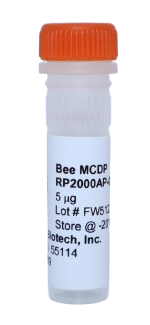
Bee MCDP Recombinant Protein
- Catalog Number:
- RP2000AP
- Availability:
- In stock
- Application:
- Cell Culture, Control, ELISA, ELISpot Control, Western Blot Control
- 100% Homology:
- Apis mellifera (honey bee)
 Powered by Bioz
 - Bee MCDP (Mast Cell Degranulating Peptide) (catalog RP2000AP) is a yeast-derived peptide supplied lyophilized without carrier protein in 10% trehalose; it has no affinity tags and is naturally endotoxin-free, and should be reconstituted in sterile PBS that contains at least 0.1% carrier protein. The peptide is ~2.6 kDa, 23 amino acids long (full sequence provided), and >98% pure by SDS-PAGE, with 100% amino-acid homology to honey bee. Store at -20°C (stable up to twelve months from date of receipt; working aliquots with carrier protein stable ~3 months) and avoid repeated freeze/thaw cycles. Product origin is the USA. It is commonly used to study mast cell activation and immune responses (including induction of mast cell degranulation and investigation of allergic and inflammatory mechanisms); typical experimental uses include cell-culture stimulation and activation assays, signaling studies, ELISA and functional assays, flow-cytometry and Western blot controls, and antibody generation/validation. Kingfisher Biotech products are supplied for research applications and are not intended for medicinal, diagnostic, or therapeutic use.
| Amino Acid Sequence | IKCNCKRHVI KPHICRKICG KNG (23) |
| Endotoxin | Naturally endotoxin-free |
| Form | Lyophilized |
| Storage Conditions | -20°C |
| Molecular Weight | 2.6 kDa |
| Purity | >98% as visualized by SDS-PAGE analysis. |
| Expression System | Yeast |
| Form | Lyophilized |
| Country Of Origin | USA |
Bee Mast Cell Degranulating Peptide (MCDP) is a biologically active peptide derived from honeybee (Apis mellifera) venom that plays a role in modulating immune and inflammatory responses. MCDP is a small peptide component of bee venom that can induce degranulation of mast cells, leading to the release of histamine and other inflammatory mediators involved in allergic and inflammatory reactions. Through these effects, bee MCDP contributes to the physiological responses associated with bee stings, including local inflammation, pain, and immune activation. In addition to its effects on mast cells, MCDP has been reported to interact with ion channels and influence neuronal signaling pathways. In cell culture, purified or synthetic bee MCDP is commonly used to stimulate mast cell degranulation, investigate mechanisms of allergic inflammation, and study mast cell activation and mediator release in vitro. Bee MCDP is also used in immunological and pharmacological research to better understand mast cell biology, allergic responses, and the cellular effects of venom-derived bioactive peptides.
Citations
Please choose a size to see price
RELATED MEDIA
