Slide 1 of 1 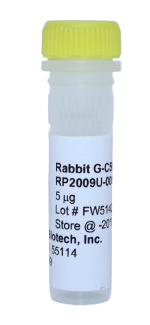
Rabbit G-CSF Recombinant Protein
- Catalog Number:
- RP2009U
- Application:
- Cell Culture, Control, ELISA, ELISpot Control, Western Blot Control
- 100% Homology:
- Oryctolagus cuniculus (rabbit)
 Powered by Bioz
 - Rabbit G-CSF (Granulocyte Colony-Stimulating Factor) (catalog RP2009U) is a yeast-derived cytokine supplied lyophilized without carrier protein in 10% trehalose; it has no affinity tags and is naturally endotoxin-free, and should be reconstituted in sterile PBS that contains at least 0.1% carrier protein. The protein is ~18.3 kDa, 170 amino acids long (full sequence provided), and >98% pure by SDS-PAGE, with 100% amino-acid homology to rabbit. Store at -20°C (stable up to twelve months from date of receipt; working aliquots with carrier protein stable ~3 months) and avoid repeated freeze/thaw cycles. Product origin is the USA. It is commonly used to study G-CSF signaling and hematopoietic processes (including regulation of neutrophil production, differentiation, and mobilization from the bone marrow); typical experimental uses include cell-culture stimulation and proliferation assays, hematopoietic and cytokine signaling studies, ELISA and neutralization assays, flow-cytometry and Western blot controls, and antibody generation/validation. Kingfisher Biotech products are supplied for research applications and are not intended for medicinal, diagnostic, or therapeutic use.
| Amino Acid Sequence | GPASSLPQGF LLKCSEQVRK IQADTSMLQE ELCATHKLCH PEELLLLGHS LGIPRAPLSS CSSQALQLPG CLSQLHSGLL LYRGLLQALA GISPASAPAL DKLQLDVADF ATTIWHQMED LGQAPAVQPT QSTMPALTSA FQRRAGSVLV ASHLQSFLEL TYRVLRYLAQ (170) |
| Endotoxin | Naturally endotoxin-free |
| Form | Lyophilized |
| Storage Conditions | -20°C |
| Molecular Weight | 18.3kDa |
| Purity | >98% as visualized by SDS-PAGE analysis. |
| Affinity Tag | None |
| aminoAcids | 170 |
| Carrier Protein | None |
| Expression System | Yeast |
| Form | Lyophilized |
| Country Of Origin | USA |
Rabbit G-CSF (Granulocyte Colony-Stimulating Factor, CSF3) is a hematopoietic cytokine belonging to the colony-stimulating factor family, which also includes GM-CSF (CSF2) and M-CSF (CSF1) that regulate the development and function of myeloid immune cells. In rabbits (Oryctolagus cuniculus), G-CSF is produced by macrophages, endothelial cells, fibroblasts, and other stromal cells in response to infection, inflammatory cytokines, or tissue injury. Rabbit G-CSF binds to the G-CSF receptor (CSF3R) expressed on myeloid progenitor cells in the bone marrow, activating intracellular signaling pathways such as JAK/STAT, MAPK/ERK, and PI3K–AKT, which promote the proliferation, differentiation, and survival of granulocytic precursor cells, particularly neutrophils. In rabbit immunity, G-CSF plays an important role in innate immune defense by regulating neutrophil production and mobilization during bacterial infection or inflammatory responses. Rabbits are also used as animal models for studying neutrophil biology and inflammatory disease, and G-CSF has been investigated in rabbit models of bacterial pneumonia, where stimulation of granulopoiesis enhances neutrophil recruitment to the lungs and improves bacterial clearance, providing insights into host defense mechanisms and therapeutic strategies for infectious diseases.
- Colony Stimulating Factor
Citations
Please choose a size to see price
RELATED MEDIA
