Slide 1 of 1 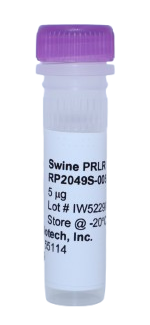
Swine Prolactin Receptor Recombinant Protein
- Catalog Number:
- RP2049S
- Availability:
- In stock
- Application:
- Cell Culture, Control, ELISA, ELISpot Control, Western Blot Control
- 100% Homology:
- Phacochoerus africanus (Common warthog), Sus scrofa (pig)
 Powered by Bioz
 - Swine PRLR (Prolactin Receptor) (catalog RP2049S) is a yeast-derived protein supplied lyophilized without carrier protein in 10% trehalose; it contains no affinity tags, is naturally endotoxin-free, and should be reconstituted in sterile PBS with at least 0.1% carrier protein. The protein is ~24.5 kDa, 212 amino acids in length (full sequence provided), and >98% pure by SDS-PAGE, with 100% amino-acid homology to pig and common warthog. It is stable for up to twelve months at -20 °C from receipt, with working aliquots (with carrier protein) stable for ~3 months; avoid repeated freeze/thaw cycles. The product is manufactured in the USA. It is commonly used to study prolactin receptor signaling and endocrine regulation, including hormone binding, receptor activation, and downstream signaling pathways; typical applications include receptor-ligand interaction studies, cell-based assays, hormone signaling research, ELISA and neutralization assays, flow cytometry and Western blot controls, and antibody development or validation. Kingfisher Biotech products are supplied for research applications only and are not intended for medicinal, diagnostic, or therapeutic use.
| Amino Acid Sequence | SPPGKPEIFK CRSPEKETFT CWWKPGADGG LPTNYTLTYH KEGETFTHEC PDYKTGGPNS CYFNKKHTSI WTIYIITVNA TNQMGSSSSD PRYVDVTYIV EPDPPVNLTL ELKKPEDQKP YLWIKWLPPT LVDVRSGWLT LQYEIRLQPE KTAEWETHFA GQQTQFKILS LYPGQKYLVQ VRCKPDHGFW SEWSPESSIQ IPNDFSMKDT TM (212) |
| Endotoxin | Naturally endotoxin-free |
| Form | Lyophilized |
| Storage Conditions | -20°C |
| Molecular Weight | 24.5kDa |
| Purity | >98% as visualized by SDS-PAGE analysis. |
| Expression System | Yeast |
| Form | Lyophilized |
| Country Of Origin | USA |
Swine Prolactin Receptor (PRLR) is a transmembrane receptor belonging to the class I cytokine receptor family, which also includes receptors for growth hormone (GHR), erythropoietin (EPOR), and several interleukins that utilize related intracellular signaling mechanisms. In pigs (Sus scrofa domesticus), PRLR binds the hormone prolactin (PRL) and activates downstream signaling pathways primarily through JAK2/STAT5, as well as MAPK and PI3K/AKT pathways, leading to regulation of genes involved in cell proliferation, differentiation, and metabolic activity. The swine prolactin receptor is expressed in multiple tissues including the mammary gland, ovary, uterus, liver, adipose tissue, and immune cells, where it mediates the physiological effects of prolactin. PRLR signaling is particularly important for mammary gland development, lactogenesis, and maintenance of milk production, supporting neonatal piglet growth and survival. It also contributes to reproductive function, maternal physiology, and metabolic regulation during pregnancy and lactation. In addition to the membrane-bound receptor, a soluble form of swine PRLR (sPRLR) can arise through alternative splicing or proteolytic cleavage, generating extracellular receptor fragments that can bind circulating prolactin and potentially modulate prolactin availability and signaling activity. Because prolactin signaling plays a key role in lactation performance, reproductive physiology, and maternal metabolism, swine PRLR and its soluble forms are studied in research on reproductive endocrinology, mammary gland biology, and genetic traits influencing sow productivity and maternal performance.
Citations
5 ug
Price: $170.00
RELATED MEDIA
