Slide 1 of 1 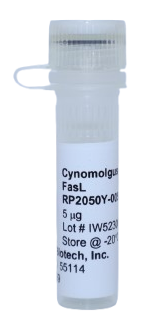
Cynomolgus Monkey Fas Ligand (TNFSF6) Recombinant Protein
- Catalog Number:
- RP2050Y
- Availability:
- In stock
- Application:
- Cell Culture, Control, ELISA, ELISpot Control, Western Blot Control
- 100% Homology:
- Macaca fascicularis (crab-eating macaque), Macaca mulatta (Rhesus monkey), Macaca nemestrina (pig-tailed macaque)
 Powered by Bioz
 - Cynomolgus Monkey FASL (Fas Ligand, CD95L) (catalog RP2050Y) is a yeast-derived cytokine supplied lyophilized without carrier protein in 10% trehalose; it contains no affinity tags, is naturally endotoxin-free, and should be reconstituted in sterile PBS with at least 0.1% carrier protein. The protein is ~20.4 kDa, 179 amino acids in length (full sequence provided), and >98% pure by SDS-PAGE, with 100% amino-acid homology to crab-eating macaque, pig-tailed macaque, and rhesus monkey. It is stable for up to twelve months at -20 °C from receipt, with working aliquots (with carrier protein) stable for ~3 months; avoid repeated freeze/thaw cycles. The product is manufactured in the USA. It is commonly used to study apoptosis and immune regulation, particularly Fas-mediated cell death signaling and immune system homeostasis; typical applications include apoptosis assays, receptor-ligand interaction studies, immune signaling research, ELISA and neutralization assays, flow cytometry and Western blot controls, and antibody development or validation. Kingfisher Biotech products are supplied for research applications only and are not intended for medicinal, diagnostic, or therapeutic use.
| Amino Acid Sequence | QLFHLQKELA ELRESTSQKH TASSLEKQIG HPSPPPEKKE QRKVAHLTGK PNSRSMPLEW EDTYGIVLLS GVKYKKGGLV INETGLYFVY SKVYFRGQSC TNLPLSHKVY MRNSKYPQDL VMMEGKMMSY CTTGQMWAHS SYLGAVFNLT SADHLYVNVS ELSLVNFEES QTFFGLYKL (179) |
| Endotoxin | Naturally endotoxin-free |
| Form | Lyophilized |
| Storage Conditions | -20°C |
| Molecular Weight | 20.4kDa |
| Purity | >98% as visualized by SDS-PAGE analysis. |
| Expression System | Yeast |
| Form | Lyophilized |
| Country Of Origin | USA |
Cynomolgus Monkey Fas Ligand (FasL, CD95L, gene FASLG) is a type II transmembrane protein belonging to the tumor necrosis factor (TNF) superfamily, which includes related ligands such as TNF-α, TRAIL (TNFSF10), and CD40L (CD154) that regulate immune signaling, inflammation, and apoptosis. In cynomolgus monkeys (Macaca fascicularis), Fas ligand is primarily expressed on activated T lymphocytes, cytotoxic T cells, and natural killer (NK) cells, where it interacts with its receptor Fas (CD95) on target cells. Binding of FasL to Fas activates the extrinsic apoptotic pathway, triggering caspase-dependent signaling cascades that induce programmed cell death. In cynomolgus monkey immunity, the Fas–FasL system plays an important role in cytotoxic T-cell–mediated elimination of infected or abnormal cells and in maintaining immune homeostasis by removing activated or autoreactive lymphocytes. Because cynomolgus monkeys share close genetic and immunological similarities with humans, they are widely used as preclinical animal models for immunology, infectious disease, and transplantation research. In these models, Fas ligand signaling has been studied in nonhuman primate models of transplantation tolerance and immune regulation, where Fas-mediated apoptosis contributes to deletion of alloreactive T cells and modulation of graft rejection responses, providing insights relevant to human immune tolerance and transplant immunology.
Citations
Please choose a size to see price
RELATED MEDIA
