Slide 1 of 1 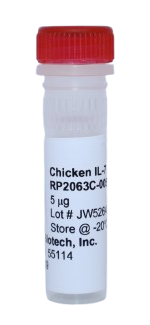
Chicken IL-7 Recombinant Protein
- Catalog Number:
- RP2063C
- Availability:
- In stock
- Application:
- Cell Culture, Control, ELISA, ELISpot Control, Western Blot Control
- 100% Homology:
- Gallus gallus (chicken)
 Powered by Bioz
 - Chicken IL-7 (Interleukin-7) (catalog RP2063C) is a yeast-derived cytokine supplied lyophilized without carrier protein in 10% trehalose; it contains no affinity tags, is naturally endotoxin-free, and should be reconstituted in sterile PBS with at least 0.1% carrier protein. The protein is ~18.5 kDa, 157 amino acids in length (full sequence provided), and >98% pure by SDS-PAGE, with 100% amino-acid homology to chicken. It is stable for up to twelve months at -20 °C from receipt, with working aliquots (with carrier protein) stable for at least ~3 months; avoid repeated freeze/thaw cycles. The product is manufactured in the USA. It is commonly used to study IL-7 signaling and immune system development, particularly in lymphocyte development, survival, and homeostasis; typical applications include cell-based assays, cytokine signaling studies, immune development research, ELISA and neutralization assays, flow cytometry and Western blot controls, and antibody development or validation. Kingfisher Biotech products are supplied for research applications only and are not intended for medicinal, diagnostic, or therapeutic use.
| Amino Acid Sequence | SSCTMGNKTT EIRVKYENIL SHDIEELVNM SAEYRDRCCK NKRHEHNKVF FCNDTQEIGS LQSMACNMLR FFNKQKINKE FRRKAALVSC GTLQVLQCKC ERHKKEKVCT QVNAPNNEDT ETVEQPKKKC NQEFCELKEN ISSLRSCWNK FEKIISR (157) |
| Endotoxin | Naturally endotoxin-free |
| Form | Lyophilized |
| Storage Conditions | -20°C |
| Molecular Weight | 18.5kDa |
| Purity | >98% as visualized by SDS-PAGE analysis. |
| Expression System | Yeast |
| Form | Lyophilized |
| Country Of Origin | USA |
Chicken Interleukin-7 (chIL-7) is a critical lymphopoietic cytokine that plays a central role in the development, survival, and homeostasis of T cells and, to a lesser extent, B cells in avian species. In chickens (Gallus gallus), IL-7 is primarily produced by stromal and epithelial cells within primary lymphoid organs, including the thymus and bursa of Fabricius, and signals through the IL-7 receptor complex composed of IL-7Rα (CD127) and the common gamma chain (γc), activating JAK/STAT pathways—particularly STAT5—to promote lymphocyte proliferation, differentiation, and survival. IL-7 is essential for thymocyte development and peripheral T-cell maintenance, making it fundamental to adaptive immune competence in poultry. Altered IL-7 expression can impact immune development, vaccine responsiveness, and resistance to infectious diseases such as avian influenza, Newcastle disease, and infectious bursal disease. In poultry health and research settings, characterization of chicken IL-7 supports studies of lymphoid organ development, immune reconstitution, vaccine enhancement strategies, and genetic selection for improved disease resistance, reinforcing its importance in both basic avian immunology and commercial poultry production.
Citations
Please choose a size to see price
RELATED MEDIA
