Slide 1 of 1 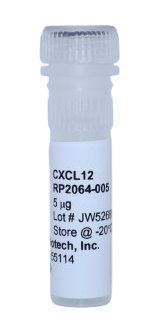
Multi-species CXCL12 (Bat, Dolphin, Feline, Guinea Pig, Human, Mink, Monkey) (SDF-1) Recombinant Protein
- Catalog Number:
- RP2064
- Availability:
- In stock
- Application:
- Cell Culture, Control, ELISA, ELISpot Control, Western Blot Control
- 100% Homology:
- Acinonyx jubatus (cheetah), Aotus nancymaae (Ma's night monkey), Apodemus sylvaticus (European woodmouse), Artibeus jamaicensis (Jamaican fruit-eating bat), Arvicanthis niloticus (Nile rat), Balaenoptera acutorostrata (minke whale), Balaenoptera musculus (blue whale), Callithrix jacchus (white-tufted-ear marmoset), Carlito syrichta (Philippine tarsier), Cavia porcellus (domestic guinea pig), Cebus imitator (Panamanian white-faced capuchin), Chlorocebus sabaeus (Cercopithecus sabaeus), Choloepus didactylus (southern two-toed sloth), Dasypus novemcinctus (nine-banded armadillo), Delphinapterus leucas (beluga whale), Delphinus delphis (saddleback dolphin), Desmodus rotundus (common vampire bat), Echinops telfairi (small Madagascar hedgehog), Enhydra lutris kenyoni (northern sea otter), Eubalaena glacialis (North Atlantic right whale), Felis catus (domestic cat), Globicephala melas (long-finned pilot whale), Gorilla gorilla gorilla (western lowland gorilla), Gulo gulo luscus (American wolverine), Homo sapiens (human), Hyaena hyaena (striped hyena), Hylobates moloch (silvery gibbon), Kogia breviceps (pygmy sperm whale), Lagenorhynchus albirostris (white-beaked dolphin), Lagenorhynchus obliquidens (Pacific white-sided dolphin), Leopardus geoffroyi (Geoffroy's cat), Lipotes vexillifer (Yangtze River dolphin), Lontra canadensis (Northern American river otter), Lutra lutra (Eurasian river otter), Lynx canadensis (Canada lynx), Macaca fascicularis (crab-eating macaque), Macaca mulatta (Rhesus monkey), Macaca nemestrina (pig-tailed macaque), Meles meles (Eurasian badger), Mesoplodon densirostris (Blainville's beaked whale), Monodon monoceros (narwhal), Nannospalax galili (Upper Galilee mountains blind mole rat), Neofelis nebulosa (Clouded leopard), Neogale vison (American mink), Neophocaena asiaeorientalis asiaeorientalis (Yangtze finless porpoise), Nomascus leucogenys (northern white-cheeked gibbon), Orcinus orca (killer whale), Pan paniscus (pygmy chimpanzee), Pan troglodytes (chimpanzee), Panthera leo (lion), Panthera onca (jaguar), Panthera pardus (leopard), Panthera tigris (tiger), Panthera uncia (snow leopard), Papio anubis (olive baboon), Phocoena phocoena (harbor porpoise), Phocoena sinus (vaquita), Phyllostomus discolor (pale spear-nosed bat), Physeter catodon (sperm whale), Piliocolobus tephrosceles (Ugandan red Colobus), Pongo abelii (Sumatran orangutan), Pongo pygmaeus (Bornean orangutan), Prionailurus bengalensis (leopard cat), Prionailurus viverrinus (fishing cat), Puma yagouaroundi (jaguarundi), Rhinopithecus bieti (black snub-nosed monkey), Rhinopithecus roxellana (golden snub-nosed monkey), Rousettus aegyptiacus (Egyptian rousette), Saimiri boliviensis boliviensis (Bolivian squirrel monkey), Sapajus apella (tufted capuchin), Sturnira hondurensis (Honduran Yellow-shouldered Bat), Suricata suricatta (meerkat), Theropithecus gelada (gelada), Trachypithecus francoisi (Francois's langur), Tupaia chinensis (Chinese tree shrew), Tursiops truncatus (common bottlenose dolphin)
 Powered by Bioz
 - CXCL12 (C-X-C Motif Chemokine Ligand 12) (catalog RP2064) is a yeast-derived cytokine supplied lyophilized without carrier protein in 10% trehalose; it contains no affinity tags, is naturally endotoxin-free, and should be reconstituted in sterile PBS with at least 0.1% carrier protein. The protein is ~7.6 kDa, 65 amino acids in length (full sequence provided), and >98% pure by SDS-PAGE, with broad amino-acid homology across species including human, common bottlenose dolphin, domestic guinea pig, domestic cat, crab-eating macaque, Egyptian rousette, common vampire bat, Jamaican fruit-eating bat, Honduran yellow-shouldered bat, American mink, cheetah, Ma's night monkey, European woodmouse, Nile rat, minke whale, blue whale, white-tufted-ear marmoset, Philippine tarsier, Panamanian white-faced capuchin, southern two-toed sloth, African green monkey, nine-banded armadillo, beluga whale, saddleback dolphin, small Madagascar hedgehog, northern sea otter, North Atlantic right whale, long-finned pilot whale, western lowland gorilla, American wolverine, striped hyena, silvery gibbon, pygmy sperm whale, white-beaked dolphin, Pacific white-sided dolphin, Geoffroy's cat, Yangtze River dolphin, North American river otter, Eurasian river otter, Canada lynx, rhesus monkey, pig-tailed macaque, Eurasian badger, Blainville's beaked whale, narwhal, blind mole rat, clouded leopard, Yangtze finless porpoise, northern white-cheeked gibbon, killer whale, bonobo, chimpanzee, lion, jaguar, leopard, tiger, snow leopard, olive baboon, harbor porpoise, vaquita, pale spear-nosed bat, sperm whale, Ugandan red colobus, Sumatran orangutan, Bornean orangutan, leopard cat, fishing cat, jaguarundi, black snub-nosed monkey, golden snub-nosed monkey, Bolivian squirrel monkey, tufted capuchin, meerkat, gelada, Francois's langur, and Chinese tree shrew. It is stable for up to twelve months at -20 °C from receipt, with working aliquots (with carrier protein) stable for ~3 months; avoid repeated freeze/thaw cycles. The product is manufactured in the USA. It is commonly used to study chemokine-mediated signaling, particularly cell migration, stem cell homing, immune cell trafficking, and CXCR4/CXCR7 signaling pathways; typical applications include chemotaxis and migration assays, stem cell and cancer research, cytokine signaling studies, ELISA and neutralization assays, flow cytometry and Western blot controls, and antibody development or validation. Kingfisher Biotech products are supplied for research applications only and are not intended for medicinal, diagnostic, or therapeutic use.
| Amino Acid Sequence | GKPVSLSYRC PCRFFESHVA RANVKHLKIL NTPNCALQIV ARLKSNNRQV CIDPKLKWIQ EYLEKALNKR FKM (73) |
| Endotoxin | Naturally endotoxin-free |
| Form | Lyophilized |
| Storage Conditions | -20°C |
| Molecular Weight | 7.6kDa |
| Purity | >98% as visualized by SDS-PAGE analysis. |
| Expression System | Yeast |
| Form | Lyophilized |
| Country Of Origin | USA |
Bat, Dolphin, Feline, Guinea Pig, Human, Mink, and Cynomolgus Monkey CXCL12 (C-X-C motif chemokine ligand 12), also known as SDF-1 (stromal cell–derived factor-1), is a homeostatic chemokine belonging to the CXC chemokine family that plays a central role in cell migration, immune cell trafficking, and tissue development. In these species, the CXCL12 protein is identical at the amino acid level (100% sequence identity), highlighting the extreme evolutionary conservation of this chemokine and reflecting its essential biological functions across mammals. CXCL12 primarily signals through the receptors CXCR4 and ACKR3 (CXCR7), regulating the migration and positioning of hematopoietic stem cells, lymphocytes, monocytes, and other progenitor cells within tissues. It is produced by stromal cells, endothelial cells, epithelial cells, fibroblasts, and bone marrow niche cells, where it contributes to hematopoiesis, immune surveillance, tissue repair, and organ development. The CXCL12–CXCR4 signaling axis is critically involved in embryonic development, cardiovascular formation, and maintenance of stem cell niches in bone marrow and lymphoid tissues. In humans and closely related primates such as cynomolgus monkeys, CXCR4 also functions as a coreceptor for HIV entry, making CXCL12 an important regulator of viral susceptibility and immune cell trafficking. Because this chemokine is structurally identical across bats, dolphins, cats, guinea pigs, humans, mink, and cynomolgus monkeys, these species provide valuable comparative and translational animal models for studying stem cell biology, cancer metastasis, immune cell migration, and host–pathogen interactions mediated by the CXCL12–CXCR4 pathway.
Citations
Please choose a size to see price
RELATED MEDIA
