Slide 1 of 1 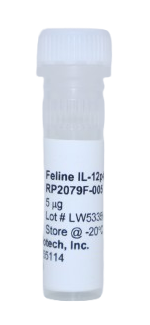
Feline IL-12/IL-23 p40 Recombinant Protein
- Catalog Number:
- RP2079F
- Availability:
- In stock
- Application:
- Cell Culture, Control, ELISA, ELISpot Control, Western Blot Control
- 100% Homology:
- Felis catus (domestic cat)
 Powered by Bioz
 - Feline IL-12 p40 (Interleukin-12 subunit p40) (catalog RP2079F) is a yeast-derived cytokine supplied lyophilized without carrier protein in 10% trehalose; it contains no affinity tags, is naturally endotoxin-free, and should be reconstituted in sterile PBS with at least 0.1% carrier protein. The protein is ~35.0 kDa, 307 amino acids in length (full sequence provided), and >98% pure by SDS-PAGE, with 100% amino-acid homology to domestic cat. It is stable for up to twelve months at -20 °C from receipt, with working aliquots (with carrier protein) stable for at least ~3 months; avoid repeated freeze/thaw cycles. The product is manufactured in the USA. It is commonly used to study IL-12 signaling and immune regulation, particularly in Th1 immune responses, cytokine production, and cell-mediated immunity; typical applications include cell-based assays, cytokine signaling studies, immune response research, ELISA and neutralization assays, flow cytometry and Western blot controls, and antibody development or validation. Kingfisher Biotech products are supplied for research applications only and are not intended for medicinal, diagnostic, or therapeutic use.
| Amino Acid Sequence | IWELEKNVYV VELDWHPDAP GEMVVLTCNT PEEDDITWTS DQSSEVLGSG KTLTIQVKEF ADAGQYTCHK GGEVLSHSFL LIHKKEDGIW STDILREQKE SKNKIFLKCE AKNYSGRFTC WWLTAISTDL KFTVKSSRGS SDPQEVTCGA ATLSAEKVRV DNRDYKKYTV ECQEGSACPA AEESLPIEVV VDAIHKLKYE NYTSSFFIRD IIKPDPPKNL QLKPLKNSRH VEVSWEYPDT WSTPHSYFSL TFGVQVQGKN NREKKDRLSV DKTSAKVVCH KDAKIRVQAR DRYYSSSWSN WASVSCS (307) |
| Endotoxin | Naturally endotoxin-free |
| Use | For Research Use Only. Not for diagnostic or therapeutic use. |
| Form | Lyophilized |
| Storage Conditions | -20°C |
| Molecular Weight | 35.0kDa |
| Purity | >98% as visualized by SDS-PAGE analysis. |
| Expression System | Yeast |
| Form | Lyophilized |
| Country Of Origin | USA |
| Use | For Research Use Only. Not for diagnostic or therapeutic use. |
Feline Interleukin-12/Interleukin-23 p40 (IL-12/IL-23 p40) is a cytokine subunit that plays an important role in regulating immune responses in cats (Felis catus). The p40 subunit is shared by two heterodimeric cytokines, IL-12 and IL-23, where it pairs with the p35 subunit to form IL-12 and with the p19 subunit to form IL-23. These cytokines are produced primarily by activated antigen-presenting cells, including macrophages and dendritic cells, in response to microbial infection or inflammatory stimuli. Feline IL-12/IL-23 p40 contributes to activation and differentiation of T helper cells and natural killer (NK) cells, promoting Th1-type immune responses and production of interferon-γ (IFN-γ). Through IL-23 signaling, the p40 subunit also supports the maintenance and expansion of Th17 cells involved in inflammatory responses and host defense. In cats, IL-12/IL-23 p40 participates in immune responses against intracellular pathogens, viruses, and other infectious agents and has been studied in the context of feline infectious diseases such as feline immunodeficiency virus (FIV) and feline infectious peritonitis (FIP). Due to similarities between feline and human immune pathways, feline IL-12/IL-23 p40 is also relevant in translational research, where feline models are used to investigate mechanisms of immune regulation, chronic inflammation, and cytokine-driven disease, as well as to evaluate immunomodulatory therapies and vaccine strategies that may inform both veterinary and human medicine.
Citations
Please choose a size to see price
RELATED MEDIA
