Slide 1 of 1 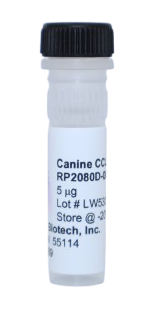
Canine CCL17 Recombinant Protein
- Catalog Number:
- RP2080D
- Availability:
- In stock
- Application:
- Cell Culture, Control, ELISA, ELISpot Control, Western Blot Control
- 100% Homology:
- Canis lupus dingo (dingo), Canis lupus familiaris (dog)
 Powered by Bioz
 - Canine CCL17 (C-C Motif Chemokine Ligand 17) (catalog RP2080D) is a yeast-derived cytokine supplied lyophilized without carrier protein in 10% trehalose; it contains no affinity tags, is naturally endotoxin-free, and should be reconstituted in sterile PBS with at least 0.1% carrier protein. The protein is ~8.6 kDa, 76 amino acids in length (full sequence provided), and >98% pure by SDS-PAGE, with 100% amino-acid homology to dog and dingo. It is stable for up to twelve months at -20 °C from receipt, with working aliquots (with carrier protein) stable for ~3 months; avoid repeated freeze/thaw cycles. The product is manufactured in the USA. It is commonly used to study chemokine-mediated immune responses, particularly T-cell recruitment, allergic inflammation, and cytokine signaling pathways; typical applications include chemotaxis and cell migration assays, immune cell activation studies, cytokine signaling research, ELISA and neutralization assays, flow cytometry and Western blot controls, and antibody development or validation. Kingfisher Biotech products are supplied for research applications only and are not intended for medicinal, diagnostic, or therapeutic use.
| Amino Acid Sequence | ARGTNVGREC CLEYFKGAIP ISRLTRWYKT SGECPKDAIV FVTVQGKSIC SDPKDKRVKK AVRYLQRTWK GGPQES (76) |
| Endotoxin | Naturally endotoxin-free |
| Form | Lyophilized |
| Storage Conditions | -20°C |
| Molecular Weight | 8.6kDa |
| Purity | >98% as visualized by SDS-PAGE analysis. |
| Expression System | Yeast |
| Form | Lyophilized |
| Country Of Origin | USA |
Canine CCL17 (C-C motif chemokine ligand 17), also known as thymus and activation-regulated chemokine (TARC), is a member of the CC chemokine family that plays a central role in regulating Th2-associated immune responses in dogs (Canis lupus familiaris). CCL17 is produced primarily by dendritic cells, macrophages, endothelial cells, and keratinocytes in response to inflammatory cytokines, particularly those linked to type 2 immunity. It functions predominantly through the CCR4 receptor to promote chemotaxis and activation of Th2 lymphocytes and regulatory T cells, contributing to allergic inflammation and immune modulation. In healthy dogs, basal circulating CCL17 levels are typically low; however, concentrations increase significantly in allergic conditions, most notably canine atopic dermatitis, where serum CCL17 has emerged as a clinically useful biomarker of disease severity and treatment response. Elevated CCL17 expression has also been observed in allergic airway disease and certain inflammatory conditions. In veterinary and translational research, canine CCL17 is widely studied as a marker of Th2 polarization and allergic inflammation, providing insight into disease pathogenesis and serving as a target for immunomodulatory therapies in canine and comparative dermatology research.
Citations
Please choose a size to see price
RELATED MEDIA
