Slide 1 of 1 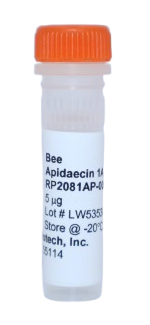
Bee Apidaecin 1A Recombinant Protein
- Catalog Number:
- RP2081AP
- Availability:
- In stock
- Application:
- Cell Culture, Control, ELISA, ELISpot Control, Western Blot Control
- 100% Homology:
- Apis mellifera (honey bee)
 Powered by Bioz
 - Bee Apidaecin 1A (catalog RP2081AP) is a yeast-derived antimicrobial peptide supplied lyophilized without carrier protein in 10% trehalose; it contains no affinity tags, is naturally endotoxin-free, and should be reconstituted in sterile PBS with at least 0.1% carrier protein. The protein is ~2.0 kDa, 17 amino acids in length (full sequence provided), and >98% pure by SDS-PAGE, with amino-acid homology to honey bee. It is stable for up to twelve months at -20 °C from receipt, with working aliquots (with carrier protein) stable for ~3 months; avoid repeated freeze/thaw cycles. The product is manufactured in the USA. It is commonly used to study antimicrobial peptide activity and innate immune defense mechanisms, including bacterial inhibition and host-pathogen interactions; typical applications include antimicrobial assays, cell-based studies, immune response research, ELISA and functional assays, and antibody development or validation. Kingfisher Biotech products are supplied for research applications only and are not intended for medicinal, diagnostic, or therapeutic use.
| Amino Acid Sequence | GNNRPVYIPQ PRPPHPR (17) |
| Endotoxin | Naturally endotoxin-free |
| Form | Lyophilized |
| Storage Conditions | -20°C |
| Molecular Weight | 2.0kDa |
| Purity | >98% as visualized by SDS-PAGE analysis. |
| Expression System | Yeast |
| Form | Lyophilized |
| Country Of Origin | USA |
Apidaecin 1A is a proline-rich antimicrobial peptide (AMP) found in honeybees (Apis mellifera) and is a key component of the insect innate immune system. It belongs to the apidaecin family of small, cationic peptides that are synthesized in the fat body and secreted into the hemolymph in response to bacterial infection, particularly Gram-negative bacteria. Unlike many antimicrobial peptides that disrupt bacterial membranes, Apidaecin 1A enters bacterial cells and inhibits intracellular targets, including components of the protein synthesis machinery, thereby blocking translation and leading to bacterial death. Its activity is highly selective for prokaryotic cells, minimizing toxicity to host tissues. Expression of Apidaecin 1A is regulated by immune signaling pathways such as the Imd pathway, which is activated by microbial recognition. In apicultural and entomological research, Apidaecin 1A is studied for its role in honeybee disease resistance, including defense against bacterial pathogens such as Paenibacillus larvae (the causative agent of American foulbrood), as well as for its potential applications as a template for novel antimicrobial therapeutics due to its stability, specificity, and mechanism of action.
Citations
5 ug
Price: $170.00
RELATED MEDIA
