Slide 1 of 1 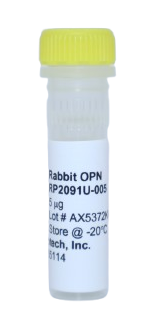
Rabbit Osteopontin (OPN) Recombinant Protein
- Catalog Number:
- RP2091U
- Availability:
- In stock
- Application:
- Cell Culture, Control, ELISA, ELISpot Control, Western Blot Control
- 100% Homology:
- Oryctolagus cuniculus (rabbit)
 Powered by Bioz
 - Rabbit OPN (Osteopontin) (catalog RP2091U) is a yeast-derived cytokine supplied lyophilized without carrier protein in 10% trehalose; it contains no affinity tags, is naturally endotoxin-free, and should be reconstituted in sterile PBS with at least 0.1% carrier protein. The protein is ~33.4 kDa, 295 amino acids in length (full sequence provided), and >98% pure by SDS-PAGE, with 100% amino-acid homology to rabbit. It is stable for up to twelve months at -20 °C from receipt, with working aliquots (with carrier protein) stable for ~3 months; avoid repeated freeze/thaw cycles. The product is manufactured in the USA. It is commonly used to study osteopontin-mediated signaling and biological processes, including cell adhesion, migration, inflammation, and immune regulation; typical applications include cell-based assays, cytokine and extracellular matrix signaling studies, inflammation research, ELISA and neutralization assays, flow cytometry and Western blot controls, and antibody development or validation. Kingfisher Biotech products are supplied for research applications only and are not intended for medicinal, diagnostic, or therapeutic use.
| Amino Acid Sequence | LPVKHADSGS SEEKQLYHKH PDALATWLNP DPSQKQNLLT PQNAMSSEEK DDLKQETLPS KSIESHDHMD DIDEDEDDDH VDNRDSNESD DADHPDDSHH SDESHQSDES DEVTVYPTED AATTVFTEVV PTVETYDGRG DSVAYRLKRS KSKMFHVSNA QYPGASEEDL SSHVDSEDLD DTPRAIPVAQ HLNVPSDWDS QEKDSHDVSQ VDDHSVETQS HEQARQYKRE ANDNSVEHSH SIDSQESSKV SQESQSREFR SHEDKLAIEP KSEEDEEHRQ LRVSHELDST SSEIN (295) |
| Endotoxin | Naturally endotoxin-free |
| Form | Lyophilized |
| Storage Conditions | -20°C |
| Molecular Weight | 33.4kDa |
| Purity | >98% as visualized by SDS-PAGE analysis. |
| Expression System | Yeast |
| Form | Lyophilized |
| Country Of Origin | USA |
Rabbit Osteopontin (OPN) (also known as SPP1, Secreted Phosphoprotein 1, bone sialoprotein I, ETA-1, or early T-lymphocyte activation-1) is a multifunctional phosphorylated glycoprotein involved in immune regulation, cell adhesion, and tissue remodeling in rabbits (Oryctolagus cuniculus). Osteopontin interacts with integrins (such as αvβ3, αvβ1, and α4β1) and CD44 receptors, activating signaling pathways that regulate cell migration, inflammatory responses, and extracellular matrix remodeling. In rabbits, OPN is produced by osteoblasts, macrophages, epithelial cells, and activated T lymphocytes, and contributes to bone metabolism, immune responses, and tissue repair. Rabbit osteopontin has been studied extensively in models of cardiovascular disease, particularly atherosclerosis, where it is associated with vascular inflammation, macrophage recruitment, and plaque development. It also plays roles in wound healing, inflammatory responses, and tissue remodeling following injury or infection. While osteopontin supports immune defense and repair processes, excessive or prolonged expression may contribute to chronic inflammation and fibrotic tissue changes. Because rabbits are widely used in cardiovascular, inflammatory, and tissue repair research, characterization of rabbit osteopontin supports studies of immune signaling, vascular inflammation, extracellular matrix remodeling, and disease pathogenesis relevant to both veterinary health and human biomedical research.
Citations
Please choose a size to see price
RELATED MEDIA
