Slide 1 of 1 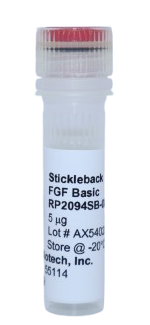
Stickleback FGF Basic Recombinant Protein
- Catalog Number:
- RP2094SB
- Availability:
- In stock
- Application:
- Cell Culture, Control, ELISA, ELISpot Control, Western Blot Control
- 100% Homology:
- Gasterosteus aculeatus aculeatus (three-spined stickleback)
 Powered by Bioz
 - Stickleback FGF Basic (Fibroblast Growth Factor Basic, FGF-2) (catalog RP2094SB) is a yeast-derived cytokine supplied lyophilized without carrier protein in 10% trehalose; it contains no affinity tags, is naturally endotoxin-free, and should be reconstituted in sterile PBS with at least 0.1% carrier protein. The protein is ~16.0 kDa, 145 amino acids in length (full sequence provided), and >98% pure by SDS-PAGE, with 100% amino-acid homology to three-spined stickleback. It is stable for up to twelve months at -20 °C from receipt, with working aliquots (with carrier protein) stable for ~3 months; avoid repeated freeze/thaw cycles. The product is manufactured in the USA. It is commonly used to study FGF signaling and cellular processes, including cell proliferation, differentiation, angiogenesis, and tissue development; typical applications include cell culture assays, growth and differentiation studies, signaling pathway research, ELISA and neutralization assays, flow cytometry and Western blot controls, and antibody development or validation. Kingfisher Biotech products are supplied for research applications only and are not intended for medicinal, diagnostic, or therapeutic use.
| Amino Acid Sequence | STPEDGGSGG FTPGGFKDPK RLYCKNGGFF LRIRSDGGVD GIREKSDAHI KLQIQATSVG EVVIKGVCAN RYLAMNRDGR LFGVRRATDE CYFLERLESN NYNTYRSRKY PGMYVALKRT GQYKSGSKTG PGQKAILFLP MSAKC (145) |
| Endotoxin | Naturally endotoxin-free |
| Form | Lyophilized |
| Storage Conditions | -20°C |
| Molecular Weight | 16.0kDa |
| Purity | >98% as visualized by SDS-PAGE analysis. |
| Expression System | Yeast |
| Form | Lyophilized |
| Country Of Origin | USA |
Stickleback Basic Fibroblast Growth Factor (FGF2, also known as bFGF) is a heparin-binding growth factor belonging to the fibroblast growth factor (FGF) family, a group of signaling proteins that regulate cell proliferation, differentiation, angiogenesis, and tissue development across vertebrates. In the three-spined stickleback (Gasterosteus aculeatus), FGF2 is expressed in developing tissues, epithelial cells, fibroblasts, and endothelial cells, where it contributes to embryonic development, tissue growth, and regeneration. FGF2 signals through fibroblast growth factor receptors (FGFRs) in the presence of heparan sulfate proteoglycans, activating conserved intracellular pathways such as MAPK/ERK and PI3K–AKT, which promote cell proliferation, migration, and vascular development. In stickleback biology, FGF2 is particularly important during embryogenesis and skeletal development, processes that are well studied in this species due to its usefulness as a model organism for evolutionary and developmental biology. Sticklebacks are widely used to study vertebrate morphological evolution and skeletal patterning, and investigation of FGF signaling pathways, including FGF2, helps researchers understand how growth factor networks regulate tissue development and evolutionary changes in vertebrate body structures.
Citations
Please choose a size to see price
RELATED MEDIA
