Slide 1 of 1 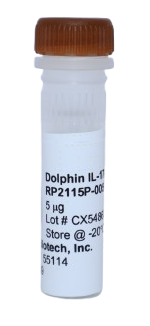
Dolphin IL-17A Recombinant Protein
- Catalog Number:
- RP2115P
- Availability:
- In stock
- Application:
- Cell Culture, Control, ELISA, ELISpot Control, Western Blot Control
- 100% Homology:
- Globicephala melas (long-finned pilot whale), Lagenorhynchus obliquidens (Pacific white-sided dolphin), Tursiops truncatus (common bottlenose dolphin)
 Powered by Bioz
 - Dolphin IL-17A (Interleukin-17A) (catalog RP2115P) is a yeast-derived cytokine supplied lyophilized without carrier protein in 10% trehalose; it contains no affinity tags, is naturally endotoxin-free, and should be reconstituted in sterile PBS with at least 0.1% carrier protein. The protein is ~14.9 kDa, 130 amino acids in length (full sequence provided), and >98% pure by SDS-PAGE, with 100% amino-acid homology to common bottlenose dolphin, Pacific white-sided dolphin, and long-finned pilot whale. It is stable for up to twelve months at -20 °C from receipt, with working aliquots (with carrier protein) stable for ~3 months; avoid repeated freeze/thaw cycles. The product is manufactured in the USA. It is commonly used to study IL-17 signaling and inflammatory responses, particularly in Th17-mediated immunity, cytokine production, and host defense; typical applications include cell-based assays, cytokine signaling studies, inflammation research, ELISA and neutralization assays, flow cytometry and Western blot controls, and antibody development or validation. Kingfisher Biotech products are supplied for research applications only and are not intended for medicinal, diagnostic, or therapeutic use.
| Amino Acid Sequence | GIIIPQSPGC PHVEDKNFPQ YVRLNLNILN RNVNSRRPSD YYKRSTSPWT LHRNEDSERY PSVIWEAKCS HLGCVNAEGK VDHHMNSVPI QQEILVLRRE PQHCPHSFRL EKMLVAVGCT CVTPIVHHMA (130) |
| Endotoxin | Naturally endotoxin-free |
| Form | Lyophilized |
| Storage Conditions | -20°C |
| Molecular Weight | 14.9kDa |
| Purity | >98% as visualized by SDS-PAGE analysis. |
| Expression System | Yeast |
| Form | Lyophilized |
| Country Of Origin | USA |
Dolphin IL-17A (Interleukin-17A) is a pro-inflammatory cytokine belonging to the IL-17 family that plays a role in host defense and inflammatory responses in dolphins (e.g., Tursiops truncatus). IL-17A is produced primarily by Th17-like CD4⁺ T cells, as well as by γδ T cells and other innate lymphoid cell populations, in response to microbial infection and immune stimulation. It acts on epithelial, endothelial, and stromal cells to induce the expression of pro-inflammatory cytokines, chemokines, and antimicrobial peptides, thereby promoting neutrophil recruitment and enhancing mucosal and barrier immunity in respiratory, gastrointestinal, and dermal tissues. In healthy dolphins, basal IL-17A expression is expected to be low, but levels may increase during bacterial or fungal infections, parasitic infestations, skin lesions, respiratory disease, or systemic inflammatory responses. In marine mammal and comparative immunology research, dolphin IL-17A is of interest for understanding Th17-mediated immunity, host responses to environmental stressors and pathogens, and the balance between protective inflammation and tissue damage in free-ranging and managed populations.
Citations
Please choose a size to see price
RELATED MEDIA
