Slide 1 of 1 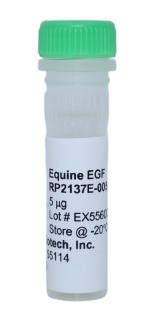
Equine EGF Recombinant Protein
- Catalog Number:
- RP2137E
- Availability:
- In stock
- Application:
- Cell Culture, Control, ELISA, ELISpot Control, Western Blot Control
- 100% Homology:
- Equus asinus (ass), Equus caballus (horse), Equus przewalskii (Przewalski's horse), Equus quagga (plains zebra)
 Powered by Bioz
 - Equine EGF (Epidermal Growth Factor) (catalog RP2137E) is a yeast-derived cytokine supplied lyophilized without carrier protein in 10% trehalose; it contains no affinity tags, is naturally endotoxin-free, and should be reconstituted in sterile PBS with at least 0.1% carrier protein. The protein is ~5.4 kDa, 48 amino acids in length (full sequence provided), and >98% pure by SDS-PAGE, with 100% amino-acid homology to horse, Przewalski's horse, donkey, and plains zebra. It is stable for up to twelve months at -20 °C from receipt, with working aliquots (with carrier protein) stable for at least ~3 months; avoid repeated freeze/thaw cycles. The product is manufactured in the USA. It is commonly used to study EGF signaling and cellular processes, including cell proliferation, differentiation, wound healing, and receptor-mediated signaling pathways; typical applications include cell culture assays, growth and differentiation studies, signaling pathway research, ELISA and neutralization assays, flow cytometry and Western blot controls, and antibody development or validation. Kingfisher Biotech products are supplied for research applications only and are not intended for medicinal, diagnostic, or therapeutic use.
| Amino Acid Sequence | NGVQSCPSTH DSYCLYDGVC FYFPDMESYA CNCVLGYMGE RCQFSDLEWW ELQ (53) |
| Endotoxin | Naturally endotoxin-free |
| Form | Lyophilized |
| Storage Conditions | -20°C |
| Molecular Weight | 5.4kDa |
| Purity | >98% as visualized by SDS-PAGE analysis. |
| Expression System | Yeast |
| Form | Lyophilized |
| Country Of Origin | USA |
Equine EGF (Epidermal Growth Factor) is a growth factor peptide belonging to the EGF family of ligands, which also includes transforming growth factor-α (TGF-α), amphiregulin (AREG), heparin-binding EGF-like growth factor (HB-EGF), betacellulin (BTC), and epiregulin (EREG) that signal through the epidermal growth factor receptor (EGFR/ErbB1) to regulate cell proliferation, differentiation, and tissue repair. In horses (Equus caballus), EGF is produced by epithelial cells, fibroblasts, macrophages, and glandular tissues, including the salivary glands and gastrointestinal epithelium, where it supports maintenance and regeneration of epithelial tissues such as the skin, cornea, and intestinal lining. Binding of EGF to EGFR activates intracellular signaling pathways including MAPK/ERK, PI3K–AKT, and JAK/STAT, promoting cell proliferation, survival, and tissue remodeling following injury or inflammation. In equine health, EGF contributes to cutaneous wound healing and mucosal repair, processes that are particularly relevant in horses due to their susceptibility to chronic or slow-healing skin wounds. Horses are also used as comparative animal models for musculoskeletal and skin repair, and EGF signaling has been studied in equine wound healing models, where EGFR-mediated pathways influence fibroblast activity, epithelial regeneration, and tissue remodeling, providing insights relevant to both veterinary medicine and human regenerative therapies.
Citations
Please choose a size to see price
RELATED MEDIA
