Slide 1 of 1 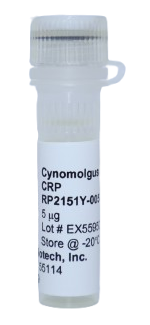
Cynomolgus Monkey CRP Recombinant Protein
- Catalog Number:
- RP2151Y
- Availability:
- In stock
- Application:
- Cell Culture, Control, ELISA, ELISpot Control, Western Blot Control
- 100% Homology:
- Macaca fascicularis (crab-eating macaque), Macaca mulatta (Rhesus monkey)
 Powered by Bioz
 - Cynomolgus Monkey CRP (C-Reactive Protein) (catalog RP2151Y) is a yeast-derived protein supplied lyophilized without carrier protein in 10% trehalose; it contains no affinity tags, is naturally endotoxin-free, and should be reconstituted in sterile PBS with at least 0.1% carrier protein. The protein is ~23.2 kDa, 206 amino acids in length (full sequence provided), and >98% pure by SDS-PAGE, with 100% amino-acid homology to crab-eating macaque and rhesus monkey. It is stable for up to twelve months at -20 °C from receipt, with working aliquots (with carrier protein) stable for ~3 months; avoid repeated freeze/thaw cycles. The product is manufactured in the USA. It is commonly used to study CRP function and inflammatory processes, including acute phase response, immune activation, and biomarker signaling; typical applications include inflammation research, biomarker studies, cell-based assays, ELISA and binding assays, flow cytometry and Western blot controls, and antibody development or validation. Kingfisher Biotech products are supplied for research applications only and are not intended for medicinal, diagnostic, or therapeutic use.
| Amino Acid Sequence | QTDMSMKAFV FPKESDNSYV TLKARLTKPL KAFTVCLHFY TELSSTRGYS IFSYATKRQN NEILIFWSKD IGYSFTVGGS EILFEVPEVT VAPVHICTSW ESASGIVEFW VDGKPRARKS LKRGYTVGED ASIILGQEQD SFGGSFETQQ SLVGDIGNVN MWDFVLSPDE ISTVYRGGTF SPSVLYWRAL KYEVQGEVFI KPQLWS (206) |
| Endotoxin | Naturally endotoxin-free |
| Form | Lyophilized |
| Storage Conditions | -20°C |
| Molecular Weight | 23.2kDa |
| Purity | >98% as visualized by SDS-PAGE analysis. |
| Expression System | Yeast |
| Form | Lyophilized |
| Country Of Origin | USA |
Cynomolgus Monkey (Macaca fascicularis) C-Reactive Protein (CRP) is an acute-phase protein belonging to the pentraxin family, which also includes serum amyloid P component (SAP) and pentraxin 3 (PTX3)—proteins involved in innate immune defense and inflammatory responses. In cynomolgus monkeys, CRP is primarily produced by hepatocytes in the liver in response to proinflammatory cytokines, particularly interleukin-6 (IL-6), as well as IL-1β and TNF-α, during infection, tissue injury, or inflammatory disease. CRP binds to phosphocholine residues on microbial membranes and damaged host cells, promoting complement activation and opsonization, thereby enhancing phagocytosis and clearance of pathogens and cellular debris. In cynomolgus monkeys, CRP functions as a sensitive biomarker of systemic inflammation, with increased circulating levels observed during infectious diseases, inflammatory conditions, and tissue injury. Because cynomolgus monkeys share close genetic, physiological, and immunological similarities with humans, CRP responses in this species closely resemble those in humans, making them important preclinical animal models for studying systemic inflammation, cardiovascular disease, infectious disease, and immune-mediated disorders. Consequently, cynomolgus monkey CRP is widely used in translational biomedical research and drug development to monitor inflammatory responses, disease progression, and therapeutic efficacy in studies relevant to human health.
Citations
Please choose a size to see price
RELATED MEDIA
