Slide 1 of 1 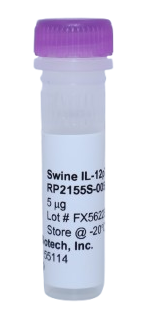
Swine IL-12 p70 Recombinant Protein
- Catalog Number:
- RP2155S
- Availability:
- In stock
- Application:
- Cell Culture, Control, ELISA, ELISpot Control, Western Blot Control
- 100% Homology:
- Sus scrofa (pig)
 Powered by Bioz
 - Swine IL-12p70 (Interleukin-12 p70) (catalog RP2155S) is a yeast-derived cytokine supplied lyophilized without carrier protein in 10% trehalose; it contains no affinity tags, is naturally endotoxin-free, and should be reconstituted in sterile PBS with at least 0.1% carrier protein. The protein is ~56.5 kDa, 499 amino acids in length (full sequence provided), and >98% pure by SDS-PAGE, with 100% amino-acid homology to pig. It is stable for up to twelve months at -20 °C from receipt, with working aliquots (with carrier protein) stable for ~3 months; avoid repeated freeze/thaw cycles. The product is manufactured in the USA. It is commonly used to study IL-12 signaling and immune regulation, particularly in Th1 immune responses, cytokine production, and cell-mediated immunity; typical applications include cell-based assays, cytokine signaling studies, immunology research, ELISA and neutralization assays, flow cytometry and Western blot controls, and antibody development or validation. Kingfisher Biotech products are supplied for research applications only and are not intended for medicinal, diagnostic, or therapeutic use.
| Amino Acid Sequence | IWELEKNVYV VELDWYPNAP GEMVVLTCNT PEEDGITWTS DQSSEVLGTG KTLTIHVKEF GDAGQYTCRK GGAVLSQSLL LLHKKEDGIW STDILKDQKE PKNKSFLKCE AKNYSGRFTC WWLTAISTDL KFSVKSSRGS TDPRGVTCGT ATLSEDLGEY KKYRVECQEG SACPAAEESL PIEVVLEAVH KLKYENYTSS FFIRDIIKPD PPKNLQLNPL KNSRHVEISW EYPDTWSTPH SYFSLMFGVQ VQGKNKREKK DKLFTDQISA KVTCHKDANI RVQARDRYYS SSWSEWASVS CN (302) LINKER RSLPATTAGP GMFKCLNHSQ NLLKAVSNTL QKAKQTLEFY SCTSEEIDHE DITKDKTSTV EACLPLELAT NESCLAARET SLITNGNCLT SGKTSFMTTL CLSSIYEDLK MYHVEFQAMN AKLLMDPKRQ IFLDQNMLTA ITELMQALNF NSETVPQKPS LEELDFYKTK IKLCILLHAF RIRAVTIDRM MSYLNSS (197) |
| Endotoxin | Naturally endotoxin-free |
| Form | Lyophilized |
| Storage Conditions | -20°C |
| Molecular Weight | 56.5kDa |
| Purity | >98% as visualized by SDS-PAGE analysis. |
| Expression System | Yeast |
| Form | Lyophilized |
| Country Of Origin | USA |
Swine Interleukin-12 p70 (IL-12 p70) is a heterodimeric cytokine that plays a central role in regulating cell-mediated immune responses in pigs (Sus scrofa). IL-12 p70 is composed of two subunits, p35 and p40, and is produced primarily by activated antigen-presenting cells such as macrophages and dendritic cells in response to microbial infection or inflammatory stimuli. Swine IL-12 p70 binds to the IL-12 receptor complex expressed on natural killer (NK) cells and T lymphocytes, activating intracellular signaling through the JAK–STAT pathway, particularly STAT4, which promotes differentiation of naïve T cells into T helper 1 (Th1) cells. This signaling enhances production of interferon-γ (IFN-γ), increases cytotoxic activity of NK cells, and strengthens cell-mediated immunity against intracellular pathogens. In pigs, IL-12 p70 contributes to host defense against bacterial and viral infections, including important swine pathogens such as porcine reproductive and respiratory syndrome virus (PRRSV), Salmonella spp., and Mycoplasma hyopneumoniae. Due to its role in regulating Th1 immune responses, swine IL-12 p70 is widely studied in veterinary immunology and translational research, particularly in investigations of host–pathogen interactions, vaccine development, and immune modulation relevant to swine health and comparative biomedical research.
Citations
5 ug
Price: $170.00
RELATED MEDIA
