Slide 1 of 1 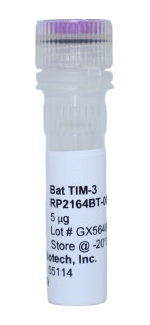
Egyptian Rousette Bat TIM-3 Recombinant Protein
- Catalog Number:
- RP2164BT
- Availability:
- In stock
- Application:
- Cell Culture, Control, ELISA, ELISpot Control, Western Blot Control
- 100% Homology:
- Rousettus aegyptiacus (Egyptian rousette)
 Powered by Bioz
 - Bat TIM-3 (T-cell Immunoglobulin and Mucin Domain-Containing Protein 3) (catalog RP2164BT) is a yeast-derived protein supplied lyophilized without carrier protein in 10% trehalose; it contains no affinity tags, is naturally endotoxin-free, and should be reconstituted in sterile PBS with at least 0.1% carrier protein. The protein is ~17.2 kDa, 168 amino acids in length (full sequence provided), and >98% pure by SDS-PAGE, with 100% amino-acid homology to Egyptian rousette bat. It is stable for up to twelve months at -20 °C from receipt, with working aliquots (with carrier protein) stable for ~3 months; avoid repeated freeze/thaw cycles. The product is manufactured in the USA. It is commonly used to study immune checkpoint regulation and T-cell signaling, including roles in immune inhibition, exhaustion, and tolerance; typical applications include receptor-ligand interaction studies, immune signaling assays, cell-based assays, ELISA and neutralization assays, flow cytometry and Western blot controls, and antibody development or validation. Kingfisher Biotech products are supplied for research applications only and are not intended for medicinal, diagnostic, or therapeutic use.
| Amino Acid Sequence | SYVVEVGQNA YLPCSYMPAT SEDLVPVCWG KGSCPAFQCH SMVLNTDGRN VNYRTSRRYQ LKGNIHKGDV SLTIENVTLA DSGIYCCRIQ FSGPMNDEKS NLRLEVNPAK VTPAWTTRRD ITAAFPRLLT TEGHDSETQS METFHDRNHT QISTSANELQ DSGATTRI (168) |
| Endotoxin | Naturally endotoxin-free |
| Form | Lyophilized |
| Storage Conditions | -20°C |
| Molecular Weight | 17.2kDa |
| Purity | >98% as visualized by SDS-PAGE analysis. |
| Expression System | Yeast |
| Form | Lyophilized |
| Country Of Origin | USA |
Egyptian Rousette Bat (Rousettus aegyptiacus) TIM-3 (T cell immunoglobulin and mucin domain-containing protein 3, also known as HAVCR2, hepatitis A virus cellular receptor 2) is an immune checkpoint receptor involved in regulation of T cell activity and immune tolerance. TIM-3 is a member of the TIM (T cell immunoglobulin and mucin domain) family of immune regulatory proteins, which includes TIM-1, TIM-3, and TIM-4, molecules that modulate immune responses and maintain immune homeostasis. In Egyptian Rousette bats, TIM-3 is likely expressed on activated T lymphocytes, natural killer (NK) cells, dendritic cells, and macrophages, where it functions as a negative regulator of immune activation. Interaction of TIM-3 with its ligands, such as galectin-9, phosphatidylserine, and HMGB1, transmits inhibitory signals that reduce T cell proliferation, cytokine production, and cytotoxic activity, helping to limit excessive inflammatory responses. Because Egyptian Rousette bats are natural reservoirs for viruses such as Marburg virus, immune checkpoint pathways like TIM-3 may contribute to the controlled immune responses and reduced immunopathology observed in bats during viral infection. Regulation of T cell activation through TIM-3 may help balance antiviral immunity with inflammation control, supporting viral tolerance while preventing tissue damage. Characterization of Egyptian Rousette Bat TIM-3 therefore contributes to research on bat antiviral immunity, immune checkpoint regulation, and host–pathogen interactions, providing insights into mechanisms of immune tolerance and viral persistence in reservoir hosts.
Citations
Please choose a size to see price
RELATED MEDIA
