Slide 1 of 1 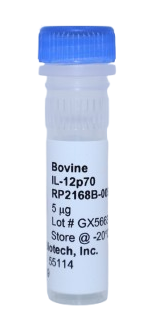
Bovine IL-12 p70 Recombinant Protein
- Catalog Number:
- RP2168B
- Availability:
- In stock
- Application:
- Cell Culture, Control, ELISA, ELISpot Control, Western Blot Control
- 100% Homology:
- Bos taurus (cattle)
 Powered by Bioz
- Bovine IL-12p70 (Interleukin-12 p70) (catalog RP2168B) is a yeast-derived cytokine supplied lyophilized without carrier protein in 10% trehalose; it contains no affinity tags, is naturally endotoxin-free, and should be reconstituted in sterile PBS with at least 0.1% carrier protein. The protein is ~57.6 kDa, 501 amino acids in length (full sequence provided), and >98% pure by SDS-PAGE, with 100% amino-acid homology to cattle. It is stable for up to twelve months at -20 °C from receipt, with working aliquots (with carrier protein) stable for ~3 months; avoid repeated freeze/thaw cycles. The product is manufactured in the USA. It is commonly used to study IL-12 signaling and immune regulation, particularly in Th1 immune responses, cytokine production, and cell-mediated immunity; typical applications include cell-based assays, cytokine signaling studies, immunology research, ELISA and neutralization assays, flow cytometry and Western blot controls, and antibody development or validation. Kingfisher Biotech products are supplied for research applications only and are not intended for medicinal, diagnostic, or therapeutic use.
| Amino Acid Sequence | MWELEKNVYV VELDWYPDAP GETVVLTCDT PEEDGITWTS DQSSEVLGSG KTLTIQVKEF GDAGQYTCHK GGEALSRSLL LLHKKEDGIW STDILKDQKE PKAKSFLKCE AKDYSGHFTC WWLTAISTDL KFSVKSSRGS SDPRGVTCGA ALLSAEKVSL EHREYNKYTV ECQEGSACPA AEESLLIEVV VEAVHKLKYE NYTSSFFIRD IIKPDPPKNL QLRPLKNSRQ VEVSWEYPDT WSTPHSYFSL TFCVQVQGKN KREKKLFMDQ TSAKVTCHKD ANVRVQARDR YYSSFWSEWA SVSCS (305) **LINKER** RSLPTTTASP GRSCLDYSQN LLRAVSNTLQ KARQTLEFYS CTSEEIDHED ITKDKTSTVE ACLPLELATN ESCLASRETS FITNGHCLAS GKTSFMTTLC LRSIYEDLKM YHVEFQAMNA KLLMDPKRQI FLDQNMLAAI AELMQALNFD SETVPQKPSL KELDFYKTKV KLCILLHAFR IRAVTIDRMM SYLSSS (196) |
| Endotoxin | Naturally endotoxin-free |
| Use | For Research Use Only. Not For Diagnostic Or Therapeutic Use. |
| Form | Lyophilized |
| Storage Conditions | -20°C |
| Molecular Weight | 57.6kDa |
| Purity | >98% as visualized by SDS-PAGE analysis. |
| Expression System | Yeast |
| Form | Lyophilized |
| Country Of Origin | USA |
Bovine Interleukin-12 p70 (IL-12 p70) is a heterodimeric cytokine that plays a central role in regulating cell-mediated immune responses in cattle (Bos taurus). IL-12 p70 is composed of two subunits, p35 and p40, which are produced primarily by activated antigen-presenting cells such as macrophages and dendritic cells in response to microbial infection or inflammatory stimuli. Bovine IL-12 p70 binds to the IL-12 receptor complex expressed on natural killer (NK) cells and T lymphocytes, activating intracellular signaling through the JAK–STAT pathway, particularly STAT4, which promotes differentiation of naïve T cells into T helper 1 (Th1) cells. This signaling leads to increased production of interferon-γ (IFN-γ), enhanced cytotoxic activity of NK cells, and strengthened cell-mediated immunity against intracellular pathogens. In cattle, IL-12 p70 plays an important role in host defense against bacterial and protozoan infections, including pathogens such as Mycobacterium bovis, Salmonella spp., and Theileria spp. Due to its key role in regulating Th1 immune responses, bovine IL-12 p70 is widely studied in veterinary immunology and translational research, particularly in studies of bovine tuberculosis, vaccine development, and host–pathogen interactions relevant to livestock health and comparative biomedical research.
Citations
Please choose a size to see price
RELATED MEDIA
