Slide 1 of 1 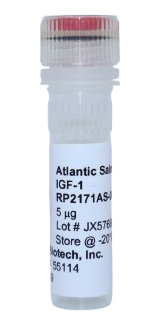
Atlantic Salmon IGF-1 Recombinant Protein
- Catalog Number:
- RP2171AS
- Availability:
- In stock
- Application:
- Cell Culture, Control, ELISA, ELISpot Control, Western Blot Control
- 100% Homology:
- Oncorhynchus keta (chum salmon), Oncorhynchus mykiss (rainbow trout), Oncorhynchus nerka (sockeye salmon), Salmo salar (Atlantic salmon), Salmo trutta (river trout), Salvelinus alpinus (Arctic char), Salvelinus fontinalis (brook trout), Salvelinus namaycush (lake trout)
 Powered by Bioz
 - Atlantic Salmon IGF-1 (Insulin-Like Growth Factor 1) (catalog RP2171AS) is a yeast-derived cytokine supplied lyophilized without carrier protein in 10% trehalose; it contains no affinity tags, is naturally endotoxin-free, and should be reconstituted in sterile PBS with at least 0.1% carrier protein. The protein is ~15.1 kDa, 136 amino acids in length (full sequence provided), and >98% pure by SDS-PAGE, with 100% amino-acid homology to Atlantic salmon, rainbow trout, sockeye salmon, chum salmon, Arctic char, river trout, lake trout, and brook trout. It is stable for up to twelve months at -20 °C from receipt, with working aliquots (with carrier protein) stable for ~3 months; avoid repeated freeze/thaw cycles. The product is manufactured in the USA. It is commonly used to study IGF signaling and growth regulation, including roles in cell proliferation, differentiation, metabolism, and developmental biology; typical applications include cell culture assays, growth and differentiation studies, signaling pathway research, ELISA and neutralization assays, flow cytometry and Western blot controls, and antibody development or validation. Kingfisher Biotech products are supplied for research applications only and are not intended for medicinal, diagnostic, or therapeutic use.
| Amino Acid Sequence | ATGAGPETLC GAELVDTLQF VCGERGFYFS KPTGYGPSSR RSHNRGIVDE CCFQSCELRR LEMYCAPVKS GKAARSVRAQ RHTDMPRTPK VSTAVQNVDR GTERRTAQHP DKTKTKKEVH QKNSSRGNTG GRNYRM (136) |
| Endotoxin | Naturally endotoxin-free |
| Form | Lyophilized |
| Storage Conditions | -20°C |
| Molecular Weight | 15.1 kDa |
| Purity | >98% as visualized by SDS-PAGE analysis. |
| Expression System | Yeast |
| Form | Lyophilized |
| Country Of Origin | USA |
Atlantic Salmon Insulin-like Growth Factor 1 (IGF-1) is a peptide growth factor that plays a central role in regulating growth, development, and metabolic processes in Atlantic salmon (Salmo salar). IGF-1 is produced primarily in the liver in response to growth hormone stimulation and circulates in the bloodstream bound to insulin-like growth factor binding proteins (IGFBPs), which regulate its stability, transport, and bioavailability. It is also expressed locally in multiple tissues including muscle, bone, gill, and intestine, where it acts through autocrine and paracrine signaling. Atlantic salmon IGF-1 binds to the insulin-like growth factor 1 receptor (IGF1R), a transmembrane tyrosine kinase receptor that activates intracellular signaling pathways such as PI3K–AKT and MAPK, regulating cell proliferation, differentiation, protein synthesis, and survival. In Atlantic salmon, IGF-1 plays a critical role in somatic growth, skeletal and muscle development, and metabolic regulation, and it is also an important mediator of smoltification—the physiological transition that prepares juvenile salmon for seawater adaptation. Due to these functions, IGF-1 is widely studied in fish physiology, aquaculture, and developmental biology, where circulating IGF-1 levels are commonly used as a biomarker of growth performance, nutritional status, and endocrine regulation of growth in salmonids.
Citations
Please choose a size to see price
RELATED MEDIA
