Slide 1 of 1 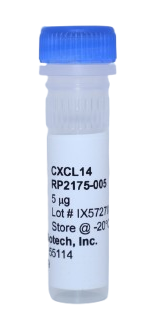
Multi-species (Bovine, Caprine, Ovine, Rat, Swine) CXCL14 Recombinant Protein
- Catalog Number:
- RP2175
- Availability:
- In stock
- Application:
- Cell Culture, Control, ELISA, ELISpot Control, Western Blot Control
- 100% Homology:
- Acomys russatus (golden spiny mouse), Apodemus sylvaticus (European woodmouse), Arvicanthis niloticus (Nile rat), Bison bison bison (American buffalo), Bos indicus (zebu), Bos mutus (wild yak), Bos taurus (cattle), Bubalus bubalis (water buffalo), Bubalus carabanensis (carabao), Budorcas taxicolor (takin), Capra hircus (goat), Cervus canadensis (elk), Chionomys nivalis (European snow vole), Echinops telfairi (small Madagascar hedgehog), Galeopterus variegatus (Sunda flying lemur), Hippopotamus amphibius kiboko (East African hippopotamus), Mastomys coucha (southern multimammate mouse), Meriones unguiculatus (Mongolian gerbil), Microtus fortis (reed vole), Microtus oregoni (creeping vole), Myodes glareolus (Bank vole), Nannospalax galili (Upper Galilee mountains blind mole rat), Odocoileus virginianus texanus (white-tailed deer), Onychomys torridus (southern grasshopper mouse), Ovis aries (sheep), Peromyscus eremicus (cactus mouse), Peromyscus leucopus (white-footed mouse), Peromyscus maniculatus bairdii (prairie deer mouse), Phacochoerus africanus (Common warthog), Phodopus roborovskii (desert hamster), Propithecus coquereli (Coquerel's sifaka), Psammomys obesus (fat sand rat), Rattus norvegicus (Norway rat), Rattus rattus (black rat), Sus scrofa (pig), Vicugna pacos (alpaca)
 Powered by Bioz
 - CXCL14 (C-X-C Motif Chemokine Ligand 14) (catalog RP2175B) is a yeast-derived cytokine supplied lyophilized without carrier protein in 10% trehalose; it contains no affinity tags, is naturally endotoxin-free, and should be reconstituted in sterile PBS with at least 0.1% carrier protein. The protein is ~9.9 kDa, 81 amino acids in length (full sequence provided), and >98% pure by SDS-PAGE, with 100% amino-acid homology to cattle, goat, sheep, Norway rat, pig, golden spiny mouse, European woodmouse, Nile rat, American buffalo, zebu, wild yak, water buffalo, carabao, takin, elk, European snow vole, small Madagascar hedgehog, Sunda flying lemur, East African hippopotamus, southern multimammate mouse, Mongolian gerbil, reed vole, creeping vole, bank vole, Upper Galilee mountains blind mole rat, white-tailed deer, southern grasshopper mouse, cactus mouse, white-footed mouse, prairie deer mouse, common warthog, desert hamster, Coquerel's sifaka, fat sand rat, black rat, and alpaca. It is stable for up to twelve months at -20 °C from receipt, with working aliquots (with carrier protein) stable for ~3 months; avoid repeated freeze/thaw cycles. The product is manufactured in the USA. It is commonly used to study CXCL14-mediated immune responses and cellular signaling, including roles in immune cell recruitment, antimicrobial activity, and tumor biology; typical applications include chemotaxis and cell migration assays, immune cell activation studies, cytokine signaling research, ELISA and neutralization assays, flow cytometry and Western blot controls, and antibody development or validation. Kingfisher Biotech products are supplied for research applications only and are not intended for medicinal, diagnostic, or therapeutic use.
| Amino Acid Sequence | RVDGSKCKCS RKGPKIRYSD VKKLEMKPKY PHCEEKMVII TTKSMSRYRG QEHCLHPKLQ STKRFIKWYN AWNEKRRVYE E (81) |
| Endotoxin | Naturally endotoxin-free |
| Use | For Research Use Only. Not for diagnostic or therapeutic use. |
| Form | Lyophilized |
| Storage Conditions | -20°C |
| Molecular Weight | 9.9kDa |
| Purity | >98% as visualized by SDS-PAGE analysis. |
| Expression System | Yeast |
| Form | Lyophilized |
| Country Of Origin | USA |
| Use | For Research Use Only. Not for diagnostic or therapeutic use. |
Bovine, Caprine, Ovine, Rat, and Swine CXCL14 (C-X-C motif chemokine ligand 14), also known as BRAK (breast and kidney–expressed chemokine), is a homeostatic chemokine belonging to the CXC chemokine family involved in immune surveillance, epithelial defense, and tissue homeostasis. In cattle (Bos taurus), goats (Capra hircus), sheep (Ovis aries), rats (Rattus norvegicus), and pigs (Sus scrofa), the CXCL14 protein is identical at the amino acid level, indicating strong evolutionary conservation and suggesting similar biological functions across these mammalian species. CXCL14 is widely expressed in epithelial tissues, skin, mucosal surfaces, and various organs, where it is produced by epithelial cells, fibroblasts, and other stromal cells. Unlike many inflammatory chemokines, CXCL14 is typically expressed under homeostatic conditions and contributes to recruitment of immune cells such as dendritic cells, monocytes, and natural killer (NK) cells, supporting early immune surveillance and maintenance of tissue integrity. In livestock species such as cattle, sheep, goats, and pigs, CXCL14 likely contributes to mucosal and epithelial immune defenses against environmental pathogens, including those affecting the skin, respiratory tract, and gastrointestinal tract. Because CXCL14 is involved in innate immune regulation, epithelial barrier defense, and immune cell recruitment, and is structurally identical across these species, it is relevant to comparative immunology, veterinary infectious disease research, and studies of epithelial immunity and inflammatory regulation.
Citations
Please choose a size to see price
RELATED MEDIA
