Slide 1 of 1 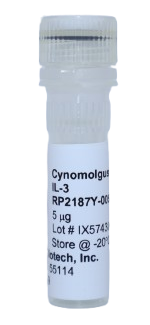
Cynomolgus Monkey IL-3 Recombinant Protein
- Catalog Number:
- RP2187Y
- Availability:
- In stock
- Application:
- Cell Culture, Control, ELISA, ELISpot Control, Western Blot Control
- 100% Homology:
- Macaca fascicularis (crab-eating macaque), Macaca mulatta (Rhesus monkey), Macaca nemestrina (pig-tailed macaque)
 Powered by Bioz
 - Cynomolgus Monkey IL-3 (Interleukin-3) (catalog RP2187Y) is a yeast-derived cytokine supplied lyophilized without carrier protein in 10% trehalose; it contains no affinity tags, is naturally endotoxin-free, and should be reconstituted in sterile PBS with at least 0.1% carrier protein. The protein is ~14.0 kDa, 124 amino acids in length (full sequence provided), and >98% pure by SDS-PAGE, with 100% amino-acid homology to crab-eating macaque, rhesus monkey, and pig-tailed macaque. It is stable for up to twelve months at -20 °C from receipt, with working aliquots (with carrier protein) stable for ~3 months; avoid repeated freeze/thaw cycles. The product is manufactured in the USA. It is commonly used to study IL-3 signaling and hematopoietic processes, including regulation of progenitor cell proliferation, differentiation, and survival; typical applications include cell-based assays, cytokine signaling studies, hematopoietic research, ELISA and neutralization assays, flow cytometry and Western blot controls, and antibody development or validation. Kingfisher Biotech products are supplied for research applications only and are not intended for medicinal, diagnostic, or therapeutic use.
| Amino Acid Sequence | APMTQTTSLK TSWAKCSNMI DEIITHLNQP PLPSPDFNNL NEEDQTILVE KNLRRSNLEA FSKAVKSLQN ASAIESILKN LPPCLPMATA APTRPPIRIT NGDRNDFRRK LKFYLKTLEN EQAQ (124) |
| Endotoxin | Naturally endotoxin-free |
| Form | Lyophilized |
| Storage Conditions | -20°C |
| Molecular Weight | 14.0kDa |
| Purity | >98% as visualized by SDS-PAGE analysis. |
| Expression System | Yeast |
| Form | Lyophilized |
| Country Of Origin | USA |
Cynomolgus monkey interleukin-3 (IL-3) is a hematopoietic growth factor produced primarily by activated T lymphocytes and mast cells that regulates the proliferation, differentiation, and survival of multipotent hematopoietic progenitor cells through signaling via the IL-3 receptor complex (IL-3Rα/CD123 and the common β chain), activating JAK/STAT, MAPK, and PI3K pathways. In cynomolgus monkeys (Macaca fascicularis), IL-3 supports the development and expansion of myeloid lineage cells—including monocytes, macrophages, dendritic cells, basophils, eosinophils, and mast cells—thereby shaping innate immunity and inflammatory responses. In nonhuman primate health, IL-3 is relevant to immune regulation during infectious diseases, allergic inflammation, and hematologic disorders. Importantly, cynomolgus monkeys are widely used as translational models in preclinical research due to their close genetic and immunological similarity to humans, making IL-3 highly relevant for studying hematopoiesis, cytokine-driven inflammation, mast cell biology, and the safety and efficacy of therapeutics targeting IL-3 or myeloid cell pathways. As such, cynomolgus monkey IL-3 plays a critical role in both primate immunology and the development of human-targeted biologics.
Citations
Please choose a size to see price
RELATED MEDIA
