Slide 1 of 1 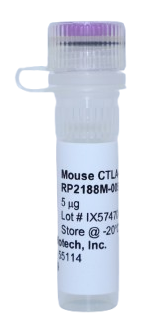
Mouse CTLA-4 Recombinant Protein
- Catalog Number:
- RP2188M
- Availability:
- In stock
- Application:
- Cell Culture, Control, ELISA, ELISpot Control, Western Blot Control
- 100% Homology:
- Mus musculus (house mouse)
 Powered by Bioz
 - Mouse CTLA-4 (Cytotoxic T-Lymphocyte-Associated Protein 4) (catalog RP2188M) is a yeast-derived protein supplied lyophilized without carrier protein in 10% trehalose; it contains no affinity tags, is naturally endotoxin-free, and should be reconstituted in sterile PBS with at least 0.1% carrier protein. The protein is ~13.9 kDa, 126 amino acids in length (full sequence provided), and >98% pure by SDS-PAGE, with 100% amino-acid homology to house mouse. It is stable for up to twelve months at -20 °C from receipt, with working aliquots (with carrier protein) stable for at least ~3 months; avoid repeated freeze/thaw cycles. The product is manufactured in the USA. It is commonly used to study immune checkpoint regulation and T-cell signaling, including roles in immune inhibition, tolerance, and T-cell activation; typical applications include receptor-ligand interaction studies, immune signaling assays, cell-based assays, ELISA and neutralization assays, flow cytometry and Western blot controls, and antibody development or validation. Kingfisher Biotech products are supplied for research applications only and are not intended for medicinal, diagnostic, or therapeutic use.
| Amino Acid Sequence | EAIQVTQPSV VLASSHGVAS FPCEYSPSHN TDEVRVTVLR QTNDQMTEVC ATTFTEKNTV GFLDYPFCSG TFNESRVNLT IQGLRAVDTG LYLCKVELMY PPPYFVGMGN GTQIYVIDPE PCPDSD (126) |
| Endotoxin | Naturally endotoxin-free |
| Form | Lyophilized |
| Storage Conditions | -20°C |
| Molecular Weight | 13.9kDa |
| Purity | >98% as visualized by SDS-PAGE analysis. |
| Expression System | Yeast |
| Form | Lyophilized |
| Country Of Origin | USA |
Mouse CTLA-4 (Cytotoxic T-Lymphocyte–Associated Protein 4, also known as CD152) is an immune checkpoint receptor belonging to the immunoglobulin superfamily that functions as a critical negative regulator of T-cell activation in mice (Mus musculus). CTLA-4 is primarily expressed on activated CD4⁺ and CD8⁺ T lymphocytes and on regulatory T cells (Tregs) following antigen stimulation. It binds to the costimulatory ligands CD80 (B7-1) and CD86 (B7-2) on antigen-presenting cells such as dendritic cells, macrophages, and B cells, competing with the activating receptor CD28 for these ligands. Engagement of CTLA-4 transmits inhibitory signals that suppress T-cell proliferation, cytokine production, and immune activation, thereby maintaining immune homeostasis and peripheral tolerance. Mouse CTLA-4 has been extensively studied using genetic knockout models, where CTLA-4–deficient mice develop severe lymphoproliferative disease and fatal systemic autoimmunity, demonstrating the essential role of CTLA-4 in controlling T-cell activation. Because of these findings, mouse models have been fundamental for understanding immune checkpoint biology and for the development of CTLA-4–targeting cancer immunotherapies, including therapies such as ipilimumab, which enhance antitumor immune responses by blocking CTLA-4–mediated inhibitory signaling.
Citations
5 ug
Price: $170.00
RELATED MEDIA
