Slide 1 of 1 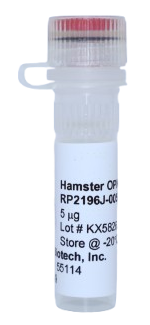
Hamster Osteopontin (OPN) Recombinant Protein
- Catalog Number:
- RP2196J
- Availability:
- In stock
- Application:
- Cell Culture, Control, ELISA, ELISpot Control, Western Blot Control
- 100% Homology:
- Mesocricetus auratus (golden hamster)
 Powered by Bioz
 - Hamster OPN (Osteopontin) (catalog RP2196J) is a yeast-derived protein supplied lyophilized without carrier protein in 10% trehalose; it contains no affinity tags, is naturally endotoxin-free, and should be reconstituted in sterile PBS with at least 0.1% carrier protein. The protein is ~33.9 kDa, 305 amino acids in length (full sequence provided), and >98% pure by SDS-PAGE, with 100% amino-acid homology to golden hamster. It is stable for up to twelve months at -20 °C from receipt, with working aliquots (with carrier protein) stable for ~3 months; avoid repeated freeze/thaw cycles. The product is manufactured in the USA. It is commonly used to study osteopontin function and cellular processes, including roles in cell adhesion, migration, immune regulation, and inflammation; typical applications include cell-based assays, signaling pathway studies, immunology research, ELISA and binding assays, flow cytometry and Western blot controls, and antibody development or validation. Kingfisher Biotech products are supplied for research applications only and are not intended for medicinal, diagnostic, or therapeutic use.
| Amino Acid Sequence | MRFAVICFCL FGIASSLPVK VADSGSSEEK LHYSKHTDAV ATWLEPDPSQ KQNLLAPQNV VSSEETDDLK QETLPSNSNE SHDHMDDDND DDDDGDHANS QDSVDSNESD DDDHPDDDHP DDSHHSDESD ESVTATTQTE VFTPAVPTVE IPDGRGDSLA YGLRAKSRKF HISDDQYPDT TDEDLSSHMK SKELVDTLKV IPVAYRLNEP SDQDSTGKTS HESSQLDEPS VETHSHEQSQ EHKQKASHES TELSDVIDSQ ESSKASQEHQ SHEDKLVPDF KSKEDTNHLK IRISHEIESS SSEVN (305) |
| Endotoxin | Naturally endotoxin-free |
| Form | Lyophilized |
| Storage Conditions | -20°C |
| Molecular Weight | 33.9kDa |
| Purity | >98% as visualized by SDS-PAGE analysis. |
| Expression System | Yeast |
| Form | Lyophilized |
| Country Of Origin | USA |
Hamster Osteopontin (OPN) (also known as SPP1, Secreted Phosphoprotein 1, bone sialoprotein I, ETA-1, or early T-lymphocyte activation-1) is a multifunctional phosphorylated glycoprotein involved in immune regulation, cell adhesion, and tissue remodeling in hamsters (commonly Mesocricetus auratus and Phodopus spp.). Osteopontin interacts with integrins (such as αvβ3, αvβ1) and CD44 receptors, activating signaling pathways that regulate cell migration, inflammatory responses, and extracellular matrix remodeling. In hamsters, OPN is produced by osteoblasts, macrophages, epithelial cells, and activated T lymphocytes, and contributes to bone metabolism, immune activation, and tissue repair processes. In research, hamster osteopontin is particularly relevant in models of inflammation, fibrosis, and viral infection, including Syrian hamster models of respiratory diseases such as SARS-CoV-2, where OPN expression is associated with macrophage recruitment, lung inflammation, and tissue remodeling during infection and recovery. OPN also participates in wound healing and fibrotic responses, influencing fibroblast activation and extracellular matrix deposition. Because hamsters are widely used as translational models for infectious disease and inflammatory pathology, characterization of hamster osteopontin supports studies of immune signaling, macrophage-mediated inflammation, and tissue remodeling mechanisms relevant to human disease.
Citations
Please choose a size to see price
RELATED MEDIA
