Slide 1 of 1 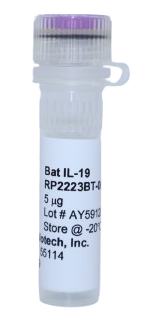
Egyptian Rousette Bat IL-19 Recombinant Protein
- Catalog Number:
- RP2223BT
- Availability:
- In stock
- Application:
- Cell Culture, Control, ELISA, ELISpot Control, Western Blot Control
- 100% Homology:
- Rousettus aegyptiacus (Egyptian rousette)
 Powered by Bioz
 - Bat IL-19 (Interleukin-19) (catalog RP2223BT) is a yeast-derived cytokine supplied lyophilized without carrier protein in 10% trehalose; it contains no affinity tags, is naturally endotoxin-free, and should be reconstituted in sterile PBS with at least 0.1% carrier protein. The protein is ~20.2 kDa, 177 amino acids in length (full sequence provided), and >98% pure by SDS-PAGE, with 100% amino-acid homology to Egyptian rousette bat. It is stable for up to twelve months at -20 °C from receipt, with working aliquots (with carrier protein) stable for ~3 months; avoid repeated freeze/thaw cycles. The product is manufactured in the USA. It is commonly used to study IL-19 signaling and immune responses, particularly in inflammation, Th2-associated cytokine activity, and immune regulation; typical applications include cell-based assays, cytokine signaling studies, immunology research, ELISA and neutralization assays, flow cytometry and Western blot controls, and antibody development or validation. Kingfisher Biotech products are supplied for research applications only and are not intended for medicinal, diagnostic, or therapeutic use.
| Amino Acid Sequence | MKAQHASLWF LGAVFFLCSV HTRGLRRCLI SMDMHHIEES FREIKGAIQA KDIFQNVTIL STSEILSSVK PLGVCCMTKN LLAFYMDRVF KDHQELNPQI LRKISSIANS FLYMQKALQQ CQEQRLCHCG QEATNATRII HDNYNQLEVQ SAALKSLGEL DIFLAWIHKN HQGTSTA (177) |
| Endotoxin | Naturally endotoxin-free |
| Form | Lyophilized |
| Storage Conditions | -20°C |
| Molecular Weight | 12.8kDa |
| Purity | >98% as visualized by SDS-PAGE analysis. |
| Expression System | Yeast |
| Form | Lyophilized |
| Country Of Origin | USA |
Egyptian rousette bat IL-19 (Interleukin-19) is a member of the IL-10 cytokine family that plays a role in regulation of inflammatory and immune responses in the Egyptian rousette bat (Rousettus aegyptiacus). IL-19 is produced primarily by monocytes, macrophages, epithelial cells, and other immune or tissue-resident cells in response to inflammatory stimulation. It signals through the IL-20 receptor complex (IL-20R1/IL-20R2) to activate downstream pathways such as STAT3, contributing to modulation of cytokine production and regulation of immune cell activity. In mammals, IL-19 is generally associated with Th2-skewed responses and anti-inflammatory or regulatory functions, helping to balance pro-inflammatory signaling. In healthy Egyptian rousette bats, basal IL-19 expression is expected to be low but may increase during infection, tissue injury, or immune activation. Given that Egyptian rousette bats are natural reservoir hosts for pathogens such as Marburg virus and other zoonotic viruses, characterization of IL-19 in this species is of particular interest for understanding mechanisms that limit immunopathology while maintaining viral tolerance. Study of Egyptian rousette bat IL-19 provides insight into immune modulation, cytokine balance, and host–pathogen interactions in bat immunology and emerging infectious disease research.
Citations
Please choose a size to see price
RELATED MEDIA
