Slide 1 of 1 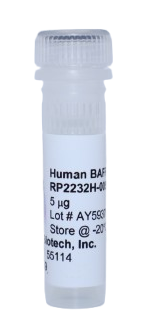
Human BAFF Receptor Recombinant Protein
- Catalog Number:
- RP2232H
- Availability:
- In stock
- Application:
- Cell Culture, Control, ELISA, ELISpot Control, Western Blot Control
- 100% Homology:
- Gorilla gorilla gorilla (western lowland gorilla), Homo sapiens (human), Pan troglodytes (chimpanzee)
 Powered by Bioz
 - Human BAFF Receptor (B-Cell Activating Factor Receptor) (catalog RP2232H) is a yeast-derived protein supplied lyophilized without carrier protein in 10% trehalose; it contains no affinity tags, is naturally endotoxin-free, and should be reconstituted in sterile PBS with at least 0.1% carrier protein. The protein is ~6.5 kDa, 65 amino acids in length (full sequence provided), and >98% pure by SDS-PAGE, with 100% amino-acid homology to human, western lowland gorilla, and chimpanzee. It is stable for up to twelve months at -20 °C from receipt, with working aliquots (with carrier protein) stable for at least ~3 months; avoid repeated freeze/thaw cycles. The product is manufactured in the USA. It is commonly used to study BAFF receptor signaling and B-cell biology, including roles in B-cell survival, maturation, and immune regulation; typical applications include receptor-ligand interaction studies, immune signaling assays, cell-based assays, ELISA and binding assays, flow cytometry and Western blot controls, and antibody development or validation. Kingfisher Biotech products are supplied for research applications only and are not intended for medicinal, diagnostic, or therapeutic use.
| Amino Acid Sequence | SLRGRDAPAP TPCVPAECFD LLVRHCVACG LLRTPRPKPA GASSPAPRTA LQPQESVGAG AGEAA (65) |
| Endotoxin | Naturally endotoxin-free |
| Form | Lyophilized |
| Storage Conditions | -20°C |
| Molecular Weight | 6.5kDa |
| Purity | >98% as visualized by SDS-PAGE analysis. |
| Expression System | Yeast |
| Form | Lyophilized |
| Country Of Origin | USA |
Human BAFF receptor (BAFF-R), also known as TNFRSF13C or CD268, is a member of the tumor necrosis factor receptor (TNFR) superfamily and serves as the primary receptor for BAFF (B cell–Activating Factor/BLyS). BAFF-R is expressed predominantly on transitional and mature naïve B cells, with lower expression on memory B cells and minimal expression on plasma cells. Engagement of BAFF-R by BAFF activates key intracellular signaling pathways, particularly the non-canonical NF-κB pathway, promoting B cell survival, maturation, metabolic fitness, and peripheral B cell homeostasis. BAFF-R signaling is essential for the maintenance of the mature B cell compartment; genetic deficiency or functional impairment of BAFF-R results in reduced peripheral B cell numbers and impaired antibody responses. Conversely, excessive BAFF–BAFF-R signaling contributes to pathological B cell survival and autoantibody production. Dysregulation of BAFF-R signaling has been implicated in autoimmune diseases such as systemic lupus erythematosus (SLE), Sjögren’s syndrome, and rheumatoid arthritis, as well as in B cell malignancies including chronic lymphocytic leukemia (CLL) and certain lymphomas. In clinical and translational research, human BAFF-R is studied as a key regulator of B cell–mediated immunity and as a therapeutic target for modulating pathological B cell survival and antibody-driven disease.
Citations
Please choose a size to see price
RELATED MEDIA
