Slide 1 of 1 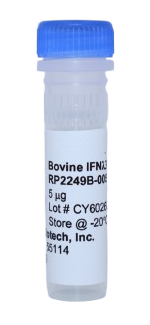
Bovine IFN lambda 3 (IL-28B) Recombinant Protein
- Catalog Number:
- RP2249B
- Availability:
- In stock
- Application:
- Cell Culture, Control, ELISA, ELISpot Control, Western Blot Control
- 100% Homology:
- Bos indicus (zebu), Bos javanicus (banteng), Bos taurus (cattle)
 Powered by Bioz
 - Bovine IFN-λ3 (Interferon Lambda 3) (catalog RP2249B) is a yeast-derived cytokine supplied lyophilized without carrier protein in 10% trehalose; it contains no affinity tags, is naturally endotoxin-free, and should be reconstituted in sterile PBS with at least 0.1% carrier protein. The protein is ~19.3 kDa, 172 amino acids in length (full sequence provided), and >98% pure by SDS-PAGE, with 100% amino-acid homology to cattle, zebu, and banteng. It is stable for up to twelve months at -20 °C from receipt, with working aliquots (with carrier protein) stable for ~3 months; avoid repeated freeze/thaw cycles. The product is manufactured in the USA. It is commonly used to study interferon lambda signaling and antiviral immune responses, including roles in mucosal immunity, viral defense, and cytokine-mediated signaling pathways; typical applications include antiviral assays, cell-based assays, cytokine signaling studies, ELISA and neutralization assays, flow cytometry and Western blot controls, and antibody development or validation. Kingfisher Biotech products are supplied for research applications only and are not intended for medicinal, diagnostic, or therapeutic use.
| Amino Acid Sequence | VPVPSAPRAL PPARGCHMAQ FKSLSPQELQ AFKTARDAFE DSFLPKDWDC STHLFPRTRD LKHLQVWERP VALEAELALT LTVLEAMANS SLGHSLEQPL LTLQNIHSKL QACVPAQPTA SSRPRGRLHH WLHRLQEARK ESQDCLEASV MFNLLRLLTR DLKCVASGDQ CV (172) |
| Endotoxin | Naturally endotoxin-free |
| Form | Lyophilized |
| Storage Conditions | -20°C |
| Molecular Weight | 19.3 kDa |
| Purity | >98% as visualized by SDS-PAGE analysis. |
| Expression System | Yeast |
| Form | Lyophilized |
| Country Of Origin | USA |
Bovine interferon lambda 3 (IFN-λ3), also known as interleukin-28B (IL-28B), is a member of the type III interferon family (IFN-λ1/IL-29, IFN-λ2/IL-28A, IFN-λ3/IL-28B, and IFN-λ4) and functions as a key antiviral cytokine that signals through the IFNLR1 (IL-28Rα)/IL-10R2 receptor complex, activating JAK/STAT pathways and inducing interferon-stimulated genes (ISGs) that inhibit viral replication, particularly at epithelial surfaces. In cattle, IFN-λ3 plays an important role in mucosal immunity within the respiratory and gastrointestinal tracts, tissues commonly targeted by economically significant pathogens such as bovine respiratory syncytial virus (BRSV), bovine viral diarrhea virus (BVDV), parainfluenza virus type 3 (PI3), rotavirus, and coronavirus. Because type III interferons primarily act on epithelial cells and generate localized antiviral responses with less systemic inflammation than type I interferons, bovine IFN-λ3 is likely critical for controlling infection while minimizing tissue damage that can impair growth and productivity. As respiratory and enteric diseases remain major drivers of morbidity in livestock, bovine IFN-λ3 (IL-28B) is highly relevant for understanding antiviral defense mechanisms, improving vaccine strategies, and developing immunomodulatory approaches to enhance herd health and disease resilience.
Citations
5 ug
Price: $170.00
RELATED MEDIA
