Slide 1 of 1 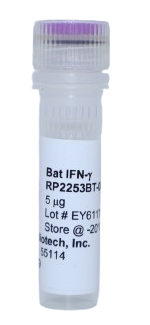
Egyptian Rousette Bat IFN gamma Recombinant Protein
- Catalog Number:
- RP2253BT
- Availability:
- In stock
- Application:
- Cell Culture, Control, ELISA, ELISpot Control, Western Blot Control
- 100% Homology:
- Rousettus aegyptiacus (Egyptian rousette) (Leu117Met)
 Powered by Bioz
 - Bat IFN-γ (Interferon Gamma) (catalog RP2253BT) is a yeast-derived cytokine supplied lyophilized without carrier protein in 10% trehalose; it contains no affinity tags, is naturally endotoxin-free, and should be reconstituted in sterile PBS with at least 0.1% carrier protein. The protein is ~16.5 kDa, 141 amino acids in length (full sequence provided), and >98% pure by SDS-PAGE, with 100% amino-acid homology to Egyptian rousette bat. It is stable for up to twelve months at -20 °C from receipt, with working aliquots (with carrier protein) stable for ~3 months; avoid repeated freeze/thaw cycles. The product is manufactured in the USA. It is commonly used to study interferon gamma signaling and immune responses, particularly in macrophage activation, antiviral defense, and Th1-mediated immunity; typical applications include cell-based assays, cytokine signaling studies, immunology research, antiviral and functional assays, ELISA and neutralization assays, flow cytometry and Western blot controls, and antibody development or validation. Kingfisher Biotech products are supplied for research applications only and are not intended for medicinal, diagnostic, or therapeutic use.
| Amino Acid Sequence | QATFFKEIEN LKDYFNASNS NVADGGTLFL DILKNWREES DKKIIQSQIV SFYFKLFEKI QDNPTIQSSV QVIKEDLRVK FFNSNNSKLE DFKKVIQIPV NNQTVLRKAI SELFNVMTDL SPKSNLRKRK RSQSPFRGWK A (141) |
| Endotoxin | Naturally endotoxin-free |
| Form | Lyophilized |
| Storage Conditions | -20°C |
| Molecular Weight | 16.5 kDa |
| Purity | >98% as visualized by SDS-PAGE analysis. |
| Expression System | Yeast |
| Form | Lyophilized |
| Country Of Origin | USA |
Egyptian Rousette Bat (Rousettus aegyptiacus) Interferon-Gamma (IFN-γ) is a type II interferon produced primarily by activated T lymphocytes and natural killer (NK) cells, where it plays a central role in cell-mediated immunity and antiviral defense. IFN-γ signals through the IFN-γ receptor complex (IFNGR1/IFNGR2), activating JAK/STAT1 pathways and inducing genes involved in macrophage activation, antigen presentation (including upregulation of MHC class I and II molecules), and coordination of cytotoxic T-cell responses. As a natural reservoir host for filoviruses such as Marburg virus, R. aegyptiacus exhibits unique immune regulatory characteristics, and IFN-γ is critical for understanding how this species mounts effective antiviral Th1-type responses while limiting excessive inflammation and immunopathology. Studies of Egyptian Rousette Bat IFN-γ contribute to insights into viral persistence, immune tolerance, and balanced pro-inflammatory signaling during experimental filovirus infection models. Characterization of IFN-γ in this species supports reservoir host immunology research, development of species-specific immune reagents, and comparative studies aimed at understanding differential disease outcomes between bats and more susceptible mammals, enhancing translational research into emerging zoonotic viral infections.
Citations
Please choose a size to see price
RELATED MEDIA
