Slide 1 of 1 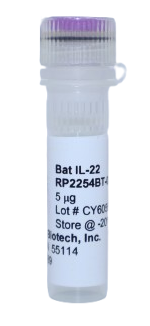
Jamaican Fruit-eating Bat IL-22 Recombinant Protein
- Catalog Number:
- RP2254BT
- Availability:
- In stock
- Application:
- Cell Culture, Control, ELISA, ELISpot Control, Western Blot Control
- 100% Homology:
- Artibeus jamaicensis (Jamaican fruit-eating bat)
 Powered by Bioz
 - Bat IL-22 (Interleukin-22) (catalog RP2254BT) is a yeast-derived cytokine supplied lyophilized without carrier protein in 10% trehalose; it contains no affinity tags, is naturally endotoxin-free, and should be reconstituted in sterile PBS with at least 0.1% carrier protein. The protein is ~17.0 kDa, 146 amino acids in length (full sequence provided), and >98% pure by SDS-PAGE, with 100% amino-acid homology to Jamaican fruit-eating bat. It is stable for up to twelve months at -20 °C from receipt, with working aliquots (with carrier protein) stable for ~3 months; avoid repeated freeze/thaw cycles. The product is manufactured in the USA. It is commonly used to study IL-22 signaling and immune responses, particularly in epithelial defense, inflammation, and cytokine-mediated signaling pathways; typical applications include cell-based assays, cytokine signaling studies, immunology research, ELISA and neutralization assays, flow cytometry and Western blot controls, and antibody development or validation. Kingfisher Biotech products are supplied for research applications only and are not intended for medicinal, diagnostic, or therapeutic use.
| Amino Acid Sequence | VPIRSHCRLD KSNFQRPYIT NHTFMLANEA SLADNNTDVR LIGEKLFHGV NMSDRCYLMK QVLNFTVEEV LLPQSDRFQP YMQEVVSFLA RLSHELNQCH IEHDDQHIRR NVQQLKDTVK KLGESGKIKA IGELNLLFMF LKNACV (146) |
| Endotoxin | Naturally endotoxin-free |
| Use | For Research Use Only. Not for diagnostic or therapeutic use. |
| Form | Lyophilized |
| Storage Conditions | -20°C |
| Molecular Weight | 17.0 kDa |
| Purity | >98% as visualized by SDS-PAGE analysis. |
| Expression System | Yeast |
| Form | Lyophilized |
| Country Of Origin | USA |
| Use | For Research Use Only. Not for diagnostic or therapeutic use. |
Jamaican fruit-eating bat IL-22 (Interleukin-22) is a member of the IL-10 cytokine family that plays an important role in mucosal immunity and epithelial barrier protection in the Jamaican fruit-eating bat (Artibeus jamaicensis). IL-22 is produced primarily by Th17 and Th22 CD4⁺ T cells, as well as by innate lymphoid cells (ILC3s), in response to microbial infection and inflammatory stimulation. It signals through the IL-22 receptor complex (IL-22R1 and IL-10R2), which is expressed mainly on epithelial and stromal cells, activating downstream JAK/STAT pathways—particularly STAT3—to induce antimicrobial peptide production, promote epithelial cell proliferation, and enhance tissue repair. In healthy bats, basal IL-22 expression is expected to be low but increases during bacterial or fungal exposure and mucosal immune challenge. As Artibeus jamaicensis is a reservoir host for various viruses and is widely studied in bat immunology, characterization of IL-22 responses provides insight into mechanisms that maintain barrier integrity while limiting excessive inflammation. Study of Jamaican fruit-eating bat IL-22 contributes to understanding epithelial immune regulation, host–pathogen interactions, and the immune tolerance strategies characteristic of bat species.
Citations
Please choose a size to see price
RELATED MEDIA
