Slide 1 of 1 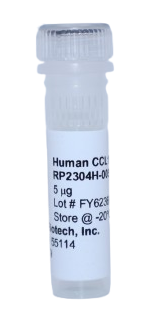
Human CCL19 (MIP-3 beta) Recombinant Protein
- Catalog Number:
- RP2304H
- Availability:
- In stock
- Application:
- Cell Culture, Control, ELISA, ELISpot Control, Western Blot Control
- 100% Homology:
- Gorilla gorilla gorilla (western lowland gorilla), Homo sapiens (human), Hylobates moloch (silvery gibbon), Nomascus leucogenys (northern white-cheeked gibbon), Symphalangus syndactylus (siamang)
 Powered by Bioz
 - Human CCL19 (C-C Motif Chemokine Ligand 19) (catalog RP2304H) is a yeast-derived cytokine supplied lyophilized without carrier protein in 10% trehalose; it contains no affinity tags, is naturally endotoxin-free, and should be reconstituted in sterile PBS with at least 0.1% carrier protein. The protein is ~8.8 kDa, 77 amino acids in length (full sequence provided), and >98% pure by SDS-PAGE, with 100% amino-acid homology to human, northern white-cheeked gibbon, western lowland gorilla, siamang, and silvery gibbon. It is stable for up to twelve months at -20 °C from receipt, with working aliquots (with carrier protein) stable for ~3 months; avoid repeated freeze/thaw cycles. The product is manufactured in the USA. It is commonly used to study chemokine-mediated immune responses, particularly lymphocyte trafficking, dendritic cell migration, and lymphoid tissue organization; typical applications include chemotaxis and cell migration assays, immune cell activation studies, cytokine signaling research, ELISA and neutralization assays, flow cytometry and Western blot controls, and antibody development or validation. Kingfisher Biotech products are supplied for research applications only and are not intended for medicinal, diagnostic, or therapeutic use.
| Amino Acid Sequence | GTNDAEDCCL SVTQKPIPGY IVRNFHYLLI KDGCRVPAVV FTTLRGRQLC APPDQPWVER IIQRLQRTSA KMKRRSS (77) |
| Endotoxin | Naturally endotoxin-free |
| Form | Lyophilized |
| Storage Conditions | -20°C |
| Molecular Weight | 8.8 kDa |
| Purity | >98% as visualized by SDS-PAGE analysis. |
| Expression System | Yeast |
| Form | Lyophilized |
| Country Of Origin | USA |
Human CCL19 (C-C motif chemokine ligand 19), also known as macrophage inflammatory protein-3β (MIP-3β) or EBI1 ligand chemokine (ELC), is a member of the CC chemokine family that plays a central role in lymphocyte trafficking and organization of secondary lymphoid tissues. CCL19 is produced primarily by stromal cells, dendritic cells, and macrophages within lymph nodes, spleen, and other secondary lymphoid organs. It signals through the CCR7 receptor to direct migration of naïve T cells, central memory T cells, regulatory T cells, and mature dendritic cells to lymphoid tissues, facilitating antigen presentation, T cell priming, and initiation of adaptive immune responses. In healthy individuals, CCL19 is essential for immune surveillance and maintenance of lymphoid architecture; however, expression may increase during infection, vaccination, chronic inflammation, and certain malignancies. Dysregulated CCL19–CCR7 signaling has been implicated in autoimmune diseases, chronic inflammatory disorders, and tumor metastasis, particularly in cancers that exploit CCR7-mediated pathways for lymph node dissemination. In clinical and translational research, human CCL19 is studied as a key regulator of adaptive immunity, lymphoid tissue organization, and immune cell trafficking, and as a potential therapeutic target in cancer immunotherapy and immune-mediated diseases.
Citations
Please choose a size to see price
RELATED MEDIA

