Slide 1 of 1 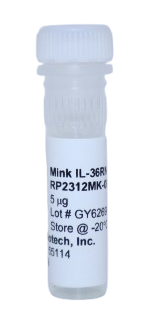
Multi-species (Mink, Ferret) IL-36 Receptor Antagonist (IL-36RA) Recombinant Protein
- Catalog Number:
- RP2312MK
- Availability:
- In stock
- Application:
- Cell Culture, Control, ELISA, ELISpot Control, Western Blot Control
- 100% Homology:
- Mustela lutreola (European mink), Mustela nigripes (black-footed ferret), Mustela putorius furo (domestic ferret), Neogale vison (American mink)
 Powered by Bioz
 - Ferret/Mink IL-36RA (Interleukin-36 Receptor Antagonist) (catalog RP2312MK) is a yeast-derived cytokine supplied lyophilized without carrier protein in 10% trehalose; it contains no affinity tags, is naturally endotoxin-free, and should be reconstituted in sterile PBS with at least 0.1% carrier protein. The protein is ~16.9 kDa, 155 amino acids in length (full sequence provided), and >98% pure by SDS-PAGE, with 100% amino-acid homology to American mink, domestic ferret, European mink, and black-footed ferret. It is stable for up to twelve months at -20 °C from receipt, with working aliquots (with carrier protein) stable for ~3 months; avoid repeated freeze/thaw cycles. The product is manufactured in the USA. It is commonly used to study IL-36 signaling and immune regulation, particularly inhibition of IL-36-mediated inflammatory responses and cytokine activity; typical applications include cell-based assays, cytokine signaling studies, inflammation research, ELISA and neutralization assays, flow cytometry and Western blot controls, and antibody development or validation. Kingfisher Biotech products are supplied for research applications only and are not intended for medicinal, diagnostic, or therapeutic use.
| Amino Acid Sequence | MVLSGALCFR MKDAALKVLY LHDNQLLAGG LHAGKVIKGE EISVVPNRSL DAKLSPVILG VQGGSQCLSC GTGQEPTLKL EPVNIMELYL GANESKSFTF YRRDTGLTSR FESAAYPGWF LCTLPEADQP LTLTQLSEDA SWGNPITDFY FQQCD (155) |
| Endotoxin | Naturally endotoxin-free |
| Form | Lyophilized |
| Storage Conditions | -20°C |
| Molecular Weight | 16.9 kDa |
| Purity | >98% as visualized by SDS-PAGE analysis. |
| Expression System | Yeast |
| Form | Lyophilized |
| Country Of Origin | USA |
Mink/Ferret Interleukin-36 Receptor Antagonist (IL-36Ra) is an anti-inflammatory cytokine that regulates IL-36–mediated immune responses in mink (Neogale vison) and ferrets (Mustela putorius furo). The IL-36Ra protein is identical at the amino acid level in these two species, reflecting strong conservation of this regulatory cytokine within mustelids. IL-36Ra is a member of the IL-1 cytokine family and functions as a natural inhibitor of the IL-36 signaling pathway by binding to the IL-36 receptor (IL-36R, also known as IL1RL2) without activating it, thereby preventing proinflammatory cytokines such as IL-36α, IL-36β, and IL-36γ from initiating downstream signaling. Through this mechanism, mink and ferret IL-36Ra suppress activation of intracellular pathways including NF-κB and MAPK, helping to limit production of inflammatory mediators and regulate immune responses at epithelial barrier tissues such as the skin and mucosal surfaces. In these species, IL-36Ra contributes to maintaining immune homeostasis and controlling excessive inflammatory responses during infection or tissue injury. In cell culture, recombinant mink/ferret IL-36Ra is commonly used to inhibit IL-36–induced inflammatory signaling in epithelial and immune cells, enabling investigation of cytokine regulation, epithelial–immune cell interactions, and inflammatory pathway modulation in vitro. Mink and ferret IL-36Ra are also studied in veterinary and translational research, particularly in investigations of inflammatory and infectious diseases in mustelids and in ferret models used to study human respiratory viruses such as influenza and SARS-CoV-2.
Citations
Please choose a size to see price
RELATED MEDIA

