Slide 1 of 1 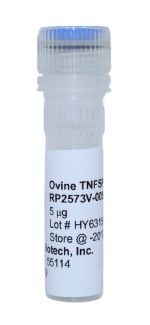
Ovine TNFSF15 Recombinant Protein
- Catalog Number:
- RP2573V
- Availability:
- In stock
- Application:
- Cell Culture, Control, ELISA, ELISpot Control, Western Blot Control
- 100% Homology:
- Budorcas taxicolor (takin), Capricornis sumatraensis (Sumatran serow), Ovibos moschatus (muskox), Ovis aries (sheep)
 Powered by Bioz
 - Ovine TNFSF15 (Tumor Necrosis Factor Superfamily Member 15) (catalog RP2573V) is a yeast-derived cytokine supplied lyophilized without carrier protein in 10% trehalose; it contains no affinity tags, is naturally endotoxin-free, and should be reconstituted in sterile PBS with at least 0.1% carrier protein. The protein is ~20.4 kDa, 180 amino acids in length (full sequence provided), and >98% pure by SDS-PAGE, with 100% amino-acid homology to sheep, takin, Sumatran serow, and muskox. It is stable for up to twelve months at -20 °C from receipt, with working aliquots (with carrier protein) stable for ~3 months; avoid repeated freeze/thaw cycles. The product is manufactured in the USA. It is commonly used to study TNFSF15 signaling and immune responses, particularly in inflammation, endothelial cell regulation, and cytokine-mediated signaling pathways; typical applications include cell-based assays, cytokine signaling studies, immunology research, ELISA and neutralization assays, flow cytometry and Western blot controls, and antibody development or validation. Kingfisher Biotech products are supplied for research applications only and are not intended for medicinal, diagnostic, or therapeutic use.
| Amino Acid Sequence | QKEQEIGPSH QRAYVPPGTD REKPRAHLTV VRQTPMQPLK NQFPALHWEH ELGLAFTKNR MNYTNKFLVI PESGDYFVYS QVTFRGTISE CGEISKGRQP NKPDSIIVVI TKVTDSYPEP TQLLMGTKSV CEIGSNWFQP IYLGAMFSLN EGDKLMVNVS DISLVDYTKE DKTFFGAFLL (180) |
| Endotoxin | Naturally endotoxin-free |
| Form | Lyophilized |
| Storage Conditions | -20°C |
| Molecular Weight | 20.4 kDa |
| Purity | >98% as visualized by SDS-PAGE analysis. |
| Expression System | Yeast |
| Form | Lyophilized |
| Country Of Origin | USA |
Ovine TNFSF15 (Tumor Necrosis Factor Superfamily Member 15, also known as TL1A or VEGI—vascular endothelial growth inhibitor) is a cytokine belonging to the tumor necrosis factor (TNF) superfamily, which includes related ligands such as TNF-α, Fas ligand (FasL), CD40 ligand (CD40L), TRAIL, and RANKL that regulate immune signaling, apoptosis, and inflammatory responses. In sheep (Ovis aries), TNFSF15 is produced primarily by endothelial cells, macrophages, dendritic cells, and other immune cells in response to infection or inflammatory stimuli. TNFSF15 exerts its biological effects mainly through binding to death receptor 3 (DR3, TNFRSF25) on T lymphocytes and other immune cells, activating intracellular signaling pathways such as NF-κB and MAPK that regulate T cell activation, cytokine production, and inflammatory responses. In ovine physiology, TNFSF15 is also associated with regulation of vascular endothelial cell growth and angiogenesis, consistent with its designation as vascular endothelial growth inhibitor (VEGI). Through these functions, TNFSF15 contributes to immune regulation, inflammatory responses, and vascular homeostasis in sheep. Because cytokines of the TNF superfamily are key mediators of host defense and inflammatory signaling, ovine TNFSF15 is of interest in veterinary immunology and infectious disease research, particularly for understanding immune responses to bacterial, viral, and parasitic infections that affect sheep health and productivity.
Citations
Please choose a size to see price
RELATED MEDIA
