Slide 1 of 1 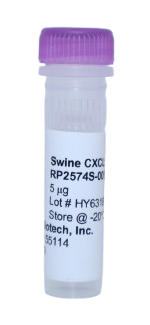
Swine CXCL12 (SDF-1) Recombinant Protein
- Catalog Number:
- RP2574S
- Availability:
- In stock
- Application:
- Cell Culture, Control, ELISA, ELISpot Control, Western Blot Control
- 100% Homology:
- Phacochoerus africanus (Common warthog), Sus scrofa (pig)
 Powered by Bioz
 - Swine CXCL12 (C-X-C Motif Chemokine Ligand 12) (catalog RP2574S) is a yeast-derived cytokine supplied lyophilized without carrier protein in 10% trehalose; it contains no affinity tags, is naturally endotoxin-free, and should be reconstituted in sterile PBS with at least 0.1% carrier protein. The protein is ~10.7 kDa, 97 amino acids in length (full sequence provided), and >98% pure by SDS-PAGE, with 100% amino-acid homology to pig and common warthog. It is stable for up to twelve months at -20 °C from receipt, with working aliquots (with carrier protein) stable for ~3 months; avoid repeated freeze/thaw cycles. The product is manufactured in the USA. It is commonly used to study chemokine-mediated immune responses, particularly stem cell homing, lymphocyte trafficking, and tissue regeneration, as well as cytokine signaling pathways; typical applications include chemotaxis and cell migration assays, stem cell and developmental studies, immune cell activation studies, cytokine signaling research, ELISA and neutralization assays, flow cytometry and Western blot controls, and antibody development or validation. Kingfisher Biotech products are supplied for research applications only and are not intended for medicinal, diagnostic, or therapeutic use.
| Amino Acid Sequence | DEKPVSLSYR CPCRFFESHV ARANIKHLKI LNTPNCALQI VARLKSNNRQ VCIDPKLKWI QEYLEKALNK PSPTLSGLTS ALGSSLASTT VGITSRS (97) |
| Endotoxin | Naturally endotoxin-free |
| Form | Lyophilized |
| Storage Conditions | -20°C |
| Molecular Weight | 10.7 kDa |
| Purity | >98% as visualized by SDS-PAGE analysis. |
| Expression System | Yeast |
| Form | Lyophilized |
| Country Of Origin | USA |
Swine CXCL12 (C-X-C motif chemokine ligand 12), also known as SDF-1 (stromal cell–derived factor-1), is a homeostatic chemokine belonging to the CXC chemokine family that plays a central role in cell migration, immune cell trafficking, and tissue development. In pigs (Sus scrofa), CXCL12 is produced by stromal cells, endothelial cells, epithelial cells, fibroblasts, and bone marrow niche cells, where it regulates the migration and positioning of hematopoietic stem cells, lymphocytes, and other progenitor cells. CXCL12 primarily signals through the receptors CXCR4 and ACKR3 (CXCR7), guiding immune cells and stem cells to specific tissues and supporting hematopoiesis, immune surveillance, tissue repair, and organ development. In swine physiology, the CXCL12–CXCR4 signaling axis plays an important role in maintaining bone marrow stem cell niches and lymphoid tissue organization. Because pigs share important anatomical and physiological similarities with humans, they are widely used as translational animal models in regenerative medicine and cardiovascular research, where CXCL12 has been studied in porcine models of myocardial infarction and tissue regeneration, in which CXCL12-mediated recruitment of CXCR4⁺ stem and progenitor cells contributes to cardiac repair and neovascularization. These studies make swine CXCL12 an important molecule for investigating stem cell trafficking, tissue repair mechanisms, and chemokine signaling in large-animal biomedical models.
Citations
5 ug
Price: $170.00
RELATED MEDIA
