Slide 1 of 1 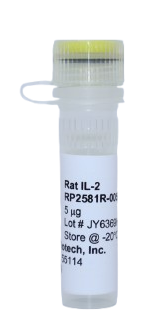
Rat IL-2 Recombinant Protein
- Catalog Number:
- RP2581R
- Availability:
- In stock
- Application:
- Cell Culture, Control, ELISA, ELISpot Control, Western Blot Control
- 100% Homology:
- Rattus norvegicus (Norway rat), Rattus rattus (black rat)
 Powered by Bioz
 - Rat IL-2 (Interleukin-2) (catalog RP2581R) is a yeast-derived cytokine supplied lyophilized without carrier protein in 10% trehalose; it contains no affinity tags, is naturally endotoxin-free, and should be reconstituted in sterile PBS with at least 0.1% carrier protein. The protein is ~15.5 kDa, 135 amino acids in length (full sequence provided), and >98% pure by SDS-PAGE, with 100% amino-acid homology to Norway rat and black rat. It is stable for up to twelve months at -20 °C from receipt, with working aliquots (with carrier protein) stable for ~3 months; avoid repeated freeze/thaw cycles. The product is manufactured in the USA. It is commonly used to study IL-2 signaling and immune responses, particularly T-cell proliferation, activation, and regulation of adaptive immunity; typical applications include cell-based assays, cytokine signaling studies, immunology research, ELISA and functional assays, flow cytometry and Western blot controls, and antibody development or validation. Kingfisher Biotech products are supplied for research applications only and are not intended for medicinal, diagnostic, or therapeutic use.
| Amino Acid Sequence | APTSSPAKET QQHLEQLLLD LQVLLRGIDN YKNLKLPMML TFKFYLPKQA TELKHLQCLE NELGALQRVL DLTQSKSFHL EDAGNFISNI RVTVVKLKGS ENKFECQFDD EPATVVEFLR RWIAICQSII STMTQ (135) |
| Endotoxin | Naturally endotoxin-free |
| Form | Lyophilized |
| Storage Conditions | -20°C |
| Molecular Weight | 15.5 kDa |
| Purity | >98% as visualized by SDS-PAGE analysis. |
| Expression System | Yeast |
| Form | Lyophilized |
| Country Of Origin | USA |
Rat IL-2 (Interleukin-2) is a central T cell–derived cytokine that regulates lymphocyte proliferation, differentiation, and immune homeostasis in rats (Rattus norvegicus). IL-2 is produced primarily by activated CD4⁺ T helper cells and, to a lesser extent, by CD8⁺ T cells following antigen recognition and costimulatory signaling. It functions through the IL-2 receptor complex (IL-2Rα/CD25, IL-2Rβ/CD122, and the common γ chain/CD132) to promote clonal expansion of antigen-specific T cells, enhance cytotoxic T lymphocyte and natural killer (NK) cell activity, and support development and maintenance of regulatory T cells (Tregs), which are critical for immune tolerance. In healthy rats, basal IL-2 expression is low but increases during infection, vaccination, and inflammatory stimulation. Dysregulated IL-2 responses have been implicated in rat models of autoimmune disease (such as adjuvant-induced arthritis and experimental autoimmune encephalomyelitis), transplant rejection, diabetes, and tumor immunity. Rats serve as important translational models for immunology, neuroinflammation, and cardiovascular research. In biomedical studies, rat IL-2 is widely used as a biomarker of T cell activation and cell-mediated immunity and as a tool for investigating immune regulation and therapeutic immunomodulation.
Citations
Please choose a size to see price
RELATED MEDIA
