Slide 1 of 1 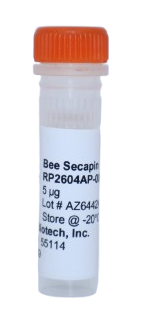
Bee Secapin Recombinant Protein
- Catalog Number:
- RP2604AP
- Availability:
- In stock
- Application:
- Cell Culture, Control, ELISA, ELISpot Control, Western Blot Control
- 100% Homology:
- Apis mellifera (honey bee), Apis mellifera carnica (Carniolan honeybee), Vespa magnifica (Asian giant hornet), Vespa velutina nigrithorax (Asian hornet)
 Powered by Bioz
 - Bee Secapin (catalog RP2604AP) is a yeast-derived peptide supplied lyophilized without carrier protein in 10% trehalose; it contains no affinity tags, is naturally endotoxin-free, and should be reconstituted in sterile PBS with at least 0.1% carrier protein. The protein is ~2.9 kDa, 25 amino acids in length (full sequence provided), and >98% pure by SDS-PAGE, with 100% amino-acid homology to honey bee, Asian giant hornet, Asian hornet, and Carniolan honeybee. It is stable for up to twelve months at -20 °C from receipt, with working aliquots (with carrier protein) stable for ~3 months; avoid repeated freeze/thaw cycles. The product is manufactured in the USA. It is commonly used to study antimicrobial peptides and innate immune responses, particularly host defense mechanisms and peptide-mediated biological activity; typical applications include antimicrobial assays, peptide function studies, innate immunity research, ELISA and binding assays, and antibody development or validation. Kingfisher Biotech products are supplied for research applications only and are not intended for medicinal, diagnostic, or therapeutic use.
| Amino Acid Sequence | YIIDVPPRCP PGSKFIKNRC RVIVP (25) |
| Endotoxin | Naturally endotoxin-free |
| Form | Lyophilized |
| Storage Conditions | -20°C |
| Molecular Weight | 2.9 kDa |
| Purity | >98% as visualized by SDS-PAGE analysis. |
| Expression System | Yeast |
| Form | Lyophilized |
| Country Of Origin | USA |
Bee Secapin is a small antimicrobial peptide (AMP) produced by the venom glands of honeybees (Apis mellifera) and related bee species. Secapin belongs to a group of cationic venom-derived peptides that participate in innate immune defense and antimicrobial activity, functioning alongside other bee antimicrobial peptides such as abaecin, apidaecin, defensin-1, and hymenoptaecin. Structurally, secapin is a short, cysteine-rich peptide stabilized by disulfide bonds, which contributes to its stability and biological activity. Secapin exhibits antimicrobial activity against bacteria and fungi, likely through interactions with microbial membranes that disrupt cell integrity or interfere with cellular processes. In bees, peptides such as secapin help protect the colony and individual insects from microbial infection following injury or venom injection. Because of its broad antimicrobial properties and structural stability, secapin has attracted interest in research on novel antimicrobial compounds, peptide therapeutics, and insect innate immunity, contributing to studies aimed at developing alternative antimicrobial agents and understanding immune defense mechanisms in insects.
Citations
Please choose a size to see price
RELATED MEDIA
