Slide 1 of 1 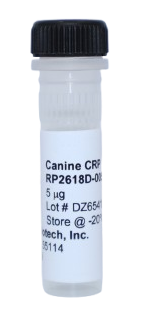
Canine CRP Recombinant Protein
- Catalog Number:
- RP2618D
- Availability:
- In stock
- Application:
- Cell Culture, Control, ELISA, ELISpot Control, Western Blot Control
- 100% Homology:
- Canis lupus baileyi (Mexican gray wolf), Canis lupus familiaris (dog)
 Powered by Bioz
 - Canine CRP (C-Reactive Protein) (catalog RP2618D) is a yeast-derived protein supplied lyophilized without carrier protein in 10% trehalose; it contains no affinity tags, is naturally endotoxin-free, and should be reconstituted in sterile PBS with at least 0.1% carrier protein. The protein is ~23.2 kDa, 204 amino acids in length (full sequence provided), and >98% pure by SDS-PAGE, with 100% amino-acid homology to dog and Mexican gray wolf. It is stable for up to twelve months at -20 °C from receipt, with working aliquots (with carrier protein) stable for at least ~3 months; avoid repeated freeze/thaw cycles. The product is manufactured in the USA. It is commonly used to study acute-phase responses and inflammation, particularly CRP-mediated immune functions, pathogen recognition, and innate immune signaling; typical applications include inflammation and biomarker studies, immune response assays, ELISA and binding assays, cell-based assays, flow cytometry and Western blot controls, and antibody development or validation. Kingfisher Biotech products are supplied for research applications only and are not intended for medicinal, diagnostic, or therapeutic use.
| Amino Acid Sequence | QIDLDEKAFV FPRESENSYV ILFPQLQKPM KAFTVCLQVY TDLTRPHSLF SYATKSQSNE ILLFKERPGL FSVSVGGSDA FINFPQKFYA PQHFCVTWES VTGLTELWVD GKPMVRASLR RGYTVGSGAS IVLGQEQDSF GGGFDKNQSL VGDIEDVNMW DFVLSPSQIL TLYTTRALSP NVLNWRNLRY ETRGEVFLKK ELWS (204) |
| Endotoxin | Naturally endotoxin-free |
| Form | Lyophilized |
| Storage Conditions | -20°C |
| Molecular Weight | 23.2kDa |
| Purity | >98% as visualized by SDS-PAGE analysis. |
| Expression System | Yeast |
| Form | Lyophilized |
| Country Of Origin | USA |
Canine C-Reactive Protein (CRP) is an acute-phase protein belonging to the pentraxin family, which also includes serum amyloid P component (SAP) and pentraxin 3 (PTX3)—proteins involved in innate immune responses and inflammation. In dogs (Canis lupus familiaris), CRP is primarily synthesized by hepatocytes in the liver in response to proinflammatory cytokines, particularly interleukin-6 (IL-6), as well as IL-1β and TNF-α, during infection, tissue injury, or inflammatory disease. CRP binds to phosphocholine residues on microbial cell membranes and damaged host cells, promoting complement activation and opsonization, which enhances clearance of pathogens and cellular debris by phagocytes. In canine medicine, CRP is considered a major acute-phase protein and is widely used as a sensitive biomarker of systemic inflammation, with elevated levels observed in bacterial infections, immune-mediated diseases, trauma, postoperative inflammation, pancreatitis, and certain cancers. Dogs also serve as valuable comparative animal models for human inflammatory diseases, as canine CRP shows similar kinetics and clinical behavior to human CRP, making it useful for studying systemic inflammation, sepsis, autoimmune diseases, cardiovascular inflammation, and cancer-associated inflammatory responses. Because many inflammatory and immune-mediated diseases occur naturally in dogs, canine CRP is frequently used in translational research, veterinary diagnostics, and comparative medicine to better understand acute-phase responses, inflammatory disease mechanisms, and therapeutic monitoring relevant to both veterinary and human health.
Citations
Please choose a size to see price
RELATED MEDIA
