Slide 1 of 1 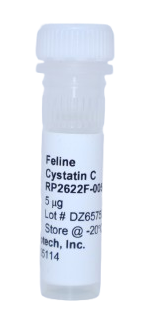
Feline Cystatin C Recombinant Protein
- Catalog Number:
- RP2622F
- Availability:
- In stock
- Application:
- Cell Culture, Control, ELISA, ELISpot Control, Western Blot Control
- 100% Homology:
- Felis catus (domestic cat), Lynx canadensis (Canada lynx), Lynx pardinus (Spanish lynx), Lynx rufus (bobcat), Prionailurus bengalensis (leopard cat), Prionailurus viverrinus (fishing cat)
 Powered by Bioz
 - Feline Cystatin C (catalog RP2622F) is a yeast-derived protein supplied lyophilized without carrier protein in 10% trehalose; it contains no affinity tags, is naturally endotoxin-free, and should be reconstituted in sterile PBS with at least 0.1% carrier protein. The protein is ~13.9 kDa, 125 amino acids in length (full sequence provided), and >98% pure by SDS-PAGE, with 100% amino-acid homology to domestic cat, Canada lynx, Spanish lynx, bobcat, leopard cat, and fishing cat. It is stable for up to twelve months at -20 °C from receipt, with working aliquots (with carrier protein) stable for ~3 months; avoid repeated freeze/thaw cycles. The product is manufactured in the USA. It is commonly used to study protease inhibition and kidney function biomarkers, particularly cystatin C-mediated regulation of cysteine proteases and its role in renal function assessment; typical applications include biomarker studies, protease activity assays, cell-based assays, ELISA and binding assays, flow cytometry and Western blot controls, and antibody development or validation. Kingfisher Biotech products are supplied for research applications only and are not intended for medicinal, diagnostic, or therapeutic use.
| Amino Acid Sequence | MSPGTGRRNN KSALVGAPLD ADVNEEGVQQ ALNFALSEYN KASNDAYHSR AMRVVRARKQ VVAGMNYFLD VEIGRTRCTK SQPNLDTCPF HDQPHLMRKT LCSFQIYTVP WMGKTSLVKS SCQDA (125) |
| Endotoxin | Naturally endotoxin-free |
| Form | Lyophilized |
| Storage Conditions | -20°C |
| Molecular Weight | 13.9 kDa |
| Purity | >98% as visualized by SDS-PAGE analysis. |
| Expression System | Yeast |
| Form | Lyophilized |
| Country Of Origin | USA |
Feline Cystatin C (CST3) is a secreted cysteine protease inhibitor belonging to the type II cystatin family, which also includes Cystatin S, Cystatin SA, and Cystatin SN. In cats (Felis catus), cystatin C is produced by a wide variety of nucleated cells and secreted into extracellular fluids such as blood, cerebrospinal fluid, and other body fluids, where it functions to inhibit cysteine proteases including cathepsins B, H, K, L, and S. Through this inhibitory activity, feline cystatin C helps regulate extracellular proteolysis, inflammation, immune responses, and tissue remodeling, protecting tissues from excessive protease-mediated damage. In feline health, cystatin C is particularly important as a biomarker of kidney function, because it is freely filtered by the glomerulus and almost completely reabsorbed and metabolized in the proximal tubules, making circulating levels reflective of glomerular filtration rate (GFR). Cats are also valuable animal models for human chronic kidney disease (CKD), a common condition in aging felines that closely resembles human disease, and cystatin C has been investigated in feline models of renal dysfunction to improve early detection of decreased kidney function and understanding of renal pathophysiology relevant to both veterinary and human medicine.
Citations
Please choose a size to see price
RELATED MEDIA
