Slide 1 of 1 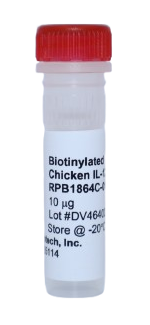
Chicken IL-12/IL-23 p40 Biotinylated Recombinant Protein
- Catalog Number:
- RPB1864C
- Availability:
- In stock
- Application:
- Cell Culture
- 100% Homology:
- Gallus gallus (chicken)
- Label:
- Biotin
 Powered by Bioz
 - The Chicken IL-12/IL-23 p40 Biotinylated yeast-derived recombinant protein is not tagged and is naturally endotoxin-free. The purity is greater than 98% as visualized by SDS-PAGE analysis. Chicken IL-12/IL-23 p40 Biotinylated applications are for cell culture. Chicken IL-12/IL-23 p40 Biotinylated yeast-derived recombinant protein can be purchased in multiple sizes. Chicken IL-12/IL-23 p40 Biotinylated Specifications: (Molecular Weight: 34.1 kDa) (Amino Acid Sequence: AQWKLRENVY VIESEWNDET PAKKVKLTCD TSDEALPVYW KKGTELKGTG KTLTTEVKEF PDAGNYTCLS AKTHEIISYS FFLITKVDSN GQMIRSILKS YKEPSKTFLK CEAKNYSGIF TCSWMTENES PSVKFTIRSL KGSQGDVTCS SPVARTDKSV TEYTAQCQKE NYCPFAEEHQ PTEMFLEVID EVEYENYTSS FFIRDIIKPD PPQCQYASTN GTVTWTYPKT WSTPKSYFPL TFRVKVESTK KYKSKVYDAD EQSIQIPKTG PKDKISVQAR DRYYNSSWSE WSTLCR (296)) (Gene ID: 404671). For research use only.
| Amino Acid Sequence | AQWKLRENVY VIESEWNDET PAKKVKLTCD TSDEALPVYW KKGTELKGTG KTLTTEVKEF PDAGNYTCLS AKTHEIISYS FFLITKVDSN GQMIRSILKS YKEPSKTFLK CEAKNYSGIF TCSWMTENES PSVKFTIRSL KGSQGDVTCS SPVARTDKSV TEYTAQCQKE NYCPFAEEHQ PTEMFLEVID EVEYENYTSS FFIRDIIKPD PPQCQYASTN GTVTWTYPKT WSTPKSYFPL TFRVKVESTK KYKSKVYDAD EQSIQIPKTG PKDKISVQAR DRYYNSSWSE WSTLCR (296) |
| Endotoxin | Naturally endotoxin-free |
| Form | Lyophilized |
| Storage Conditions | -20°C |
| Purity | >98% as visualized by SDS-PAGE analysis. |
| Expression System | Yeast |
| Form | Lyophilized |
| Country Of Origin | USA |
Chicken Interleukin-12/Interleukin-23 p40 (IL-12/IL-23 p40) is a cytokine subunit that plays an important role in regulating immune responses in chickens (Gallus gallus). The p40 subunit is shared by the heterodimeric cytokine IL-12, where it pairs with the p35 subunit to form functional IL-12 that is primarily produced by activated antigen-presenting cells such as macrophages and dendritic-like cells in response to microbial infection or inflammatory stimuli. Chicken IL-12/IL-23 p40 contributes to activation of natural killer (NK) cells and differentiation of T helper cells toward Th1-type immune responses, promoting the production of interferon-γ (IFN-γ) and enhancing cell-mediated immunity against intracellular pathogens. Through these mechanisms, IL-12 signaling plays a critical role in host defense against viral, bacterial, and protozoan infections in poultry. In chickens, IL-12/IL-23 p40 is particularly studied in immune responses to important avian pathogens such as Eimeria species (causative agents of coccidiosis), Salmonella spp., and avian influenza virus. Due to its role in regulating cellular immunity, chicken IL-12/IL-23 p40 is widely studied in poultry immunology and translational research, including investigations of vaccine efficacy, host–pathogen interactions, and strategies to enhance disease resistance and immune performance in poultry production systems.
Citations
10 ug
Price: $200.00