Slide 1 of 1 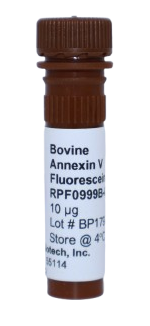
Bovine Annexin V Fluorescein
- Catalog Number:
- RPF0999B
- Availability:
- In stock
- Application:
- Flow Cytometry
- 100% Homology:
- Bos taurus (cattle)
 Powered by Bioz
 - Annexins are important in various cellular and physiological processes such as providing a membrane scaffold, which is relevant to changes in the physical shape of the cell. Annexin proteins have been shown to be involved in trafficking and organization of vesicles, exocytosis, endocytosis and also calcium ion channel formation. Annexin proteins are not exclusively intracellular protein: Annexin proteins are also found in the extracellular space and have been linked to several processes fibrinolysis, coagulation, inflammation and apoptosis. Annexin proteins are all capable of binding negatively charged phospholipids in a calcium dependent manner and contain a 70 amino acid repeat sequence called an annexin repeat. Bovine Annexin V was produced in yeast and therefore does not have endotoxin, is naturally folded, and post-translationally modified. Bovine Annexin V Fluorescein has a predicted molecular weight of 36.1 kDa. Protien Sequence: MAQVLRGTVA DFPGFDERAD AETLRKAMKG LGTDEETILT LLTSRSNAQR QEIAVAFKTL FGRDLLDDLK SELTGKFEKL IVALMKPSRL YDAYELKHAL KGAGTDEKVL TEIIASRTPE ELRAIEQVYE EEYGSSLEDD VVGDTSGYYQ RMLVVLLQAN RDPDARIDEA QVEQDAQALF QAGELKWGTD EEKFITIFGT RSVSHLRRVF DKYMTISGFQ IEETIDRETS GNLEQLLLAV VKSIRSIPAY LAETLYYAMK GAGTDDHTLI RVVVSRSEID LYNIRKEFRK NFGTSLYSMI KGDTSGDYKK ALLLLCGGED D (321).
| Amino Acid Sequence | MAQVLRGTVA DFPGFDERAD AETLRKAMKG LGTDEETILT LLTSRSNAQR QEIAVAFKTL FGRDLLDDLK SELTGKFEKL IVALMKPSRL YDAYELKHAL KGAGTDEKVL TEIIASRTPE ELRAIEQVYE EEYGSSLEDD VVGDTSGYYQ RMLVVLLQAN RDPDARIDEA QVEQDAQALF QAGELKWGTD EEKFITIFGT RSVSHLRRVF DKYMTISGFQ IEETIDRETS GNLEQLLLAV VKSIRSIPAY LAETLYYAMK GAGTDDHTLI RVVVSRSEID LYNIRKEFRK NFGTSLYSMI KGDTSGDYKK ALLLLCGGED D (321) |
| Endotoxin | Naturally endotoxin-free |
| Storage Conditions | 2°C to 8°C |
| Country Of Origin | USA |
Bovine Annexin V (also known as ANXA5, Annexin A5, placental anticoagulant protein I (PAP-I), lipocortin V, or anchorin CII) is a calcium-dependent phospholipid-binding protein belonging to the annexin family, a group of conserved proteins involved in membrane organization, cellular signaling, and regulation of inflammation and apoptosis. In cattle (Bos taurus), Annexin V binds with high affinity to phosphatidylserine exposed on the outer leaflet of the plasma membrane during early apoptosis or cell damage in the presence of calcium ions. Because of this property, FITC-labeled bovine Annexin V (Annexin V–FITC) is widely used in flow cytometry and fluorescence microscopy assays to detect apoptotic cells. When conjugated to fluorescein isothiocyanate (FITC), Annexin V enables fluorescent labeling of cells exposing phosphatidylserine, allowing quantitative detection and discrimination of early apoptotic cells—often in combination with viability dyes such as propidium iodide (PI) to distinguish early apoptosis from late apoptosis or necrosis. In bovine health and research, Annexin V–FITC assays are used to study cellular responses during infections, inflammatory conditions such as mastitis, and tissue injury. It is also applied in reproductive biology to assess sperm membrane integrity and apoptosis in spermatozoa or early embryos, which is important for fertility evaluation and assisted reproductive technologies in cattle. As a sensitive biomarker of apoptosis and membrane remodeling, FITC-labeled bovine Annexin V supports studies of host–pathogen interactions, immune regulation, cell death pathways, and reproductive cell viability in veterinary and comparative biomedical research.
Citations
10 ug (100 tests)
Price: $200.00