Slide 1 of 1 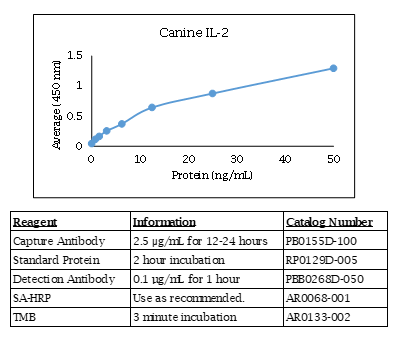
Canine IL-2 Polyclonal Antibody
- Catalog Number:
- PB0155D
- Availability:
- In stock
- Application:
- ELISA, ELISpot, Flow Cytometry, Neutralization, Western Blot
- Host:
- Rabbit
- 100% Homology:
- Canis lupus dingo (dingo), Canis lupus familiaris (dog), Nyctereutes procyonoides (raccoon dog), Vulpes lagopus (Arctic fox), Vulpes vulpes (red fox)
- Label:
- Unconjugated
- The Canine IL-2 polyclonal antibody is unlabeled and has been qualified for use in ELISA and Western blot applications. It is the capture antibody in the Kingfisher Biotech Canine IL-2 ELISA. The Canine IL-2 polyclonal antibody was produced in rabbits and is antigen-affinity purified. The reactivity by species is: (Bovine IL-2 - None) (Canine IL-2 - Strong) (Chicken IL-2 - None) (Equine IL-2 - None) (Feline IL-2 - None) (Human IL-2 - None) (Mouse IL-2 - None) (Rabbit IL-2 - None). For research use only.
| Storage Conditions | 2°C to 8°C |
| Purification | Antigen-affinity |
| Country Of Origin | USA |
- Canine IL-2 (Interleukin-2) is a central T cell-derived cytokine that regulates lymphocyte proliferation, differentiation, and immune homeostasis in dogs (Canis lupus familiaris). IL-2 is produced primarily by activated CD4⁺ and CD8⁺ T lymphocytes following antigen recognition and costimulatory signaling, and it functions through the IL-2 receptor complex (IL-2Rα/CD25, IL-2Rβ, and the common γ chain) to promote clonal expansion of antigen-specific T cells, enhance cytotoxic T lymphocyte and natural killer (NK) cell activity, and support development and maintenance of regulatory T cells (Tregs). In healthy dogs, basal IL-2 expression is typically low but increases during infection, vaccination, and immune stimulation. Altered IL-2 responses have been associated with canine distemper virus, leishmaniasis, chronic inflammatory diseases, and immune-mediated disorders. Dogs serve as important translational animal models for human lymphoma and other cancers, atopic dermatitis, autoimmune disease, and certain neuroinflammatory and infectious diseases. In veterinary and comparative medicine research, canine IL-2 is widely used as a biomarker of T cell activation and cell-mediated immunity and has been investigated as an immunotherapeutic agent in oncology and chronic infectious disease settings.
Please choose a size to see price
