Slide 1 of 1 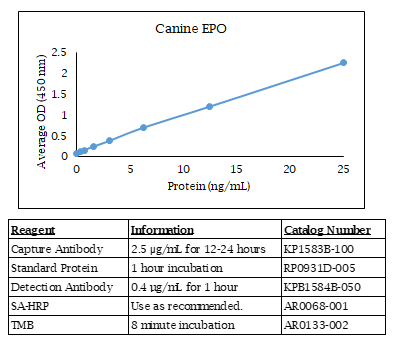
Canine Erythropoietin (EPO) ELISA
- Catalog Number:
- DIY1586D
- Availability:
- In stock
- Application:
- ELISA
- 100% Homology:
- Canis lupus dingo (dingo), Canis lupus familiaris (dog)
 Powered by Bioz
 Components
| Usage | Quantity | Component | Size |
|---|---|---|---|
| Detection Antibody | 50 µg | KPB1584B-050 | |
| Standard | 5 µg | RP0931D-005 | |
| Capture Antibody | 100 µg | KP1583B-100 | 1 Pack (<= 10 Plates) |
| Capture Antibody | 100 µg X 2 | KP1583B-100 | 1 Pack (<= 20 Plates) |
- The Canine EPO (Erythropoietin) ELISA is designed for the quantitative measurement of EPO in cell culture supernatants from dogs (Canis lupus familiaris) and can also be used to measure EPO in a variety of biological sample types reported in the literature, including serum, plasma, whole blood, kidney tissue lysates, and bone marrow samples. While the assay is optimized for cell culture supernatants, minor modifications to the protocol may be required when measuring EPO in other sample types to ensure optimal sensitivity and accuracy, allowing researchers to adjust buffers, antibody concentrations, incubation times, temperatures, and other assay conditions as needed. EPO is a glycoprotein hormone produced primarily by renal peritubular interstitial cells in response to hypoxia, where it regulates erythropoiesis by stimulating proliferation, differentiation, and survival of erythroid progenitor cells in the bone marrow through activation of the erythropoietin receptor (EPOR). In the canine animal model, EPO is widely studied in the context of chronic kidney disease-associated anemia, hypoxic injury, hemorrhage, neonatal development, and hematologic disorders, making it an important biomarker in veterinary internal medicine and translational research. Measurement of canine EPO provides insight into oxygen-sensing pathways, red blood cell production, and disease progression, with reported concentrations typically detected at low picogram-per-milliliter levels under normal physiological conditions and increasing in response to anemia, hypoxia, blood loss, or renal stimulation, depending on sample type and clinical context. The kit contains a capture antibody, detection antibody, and recombinant canine EPO protein standard for assay development, and these antibodies have been validated to function together in an ELISA format using the provided standard. The quantities of kit components are not matched, and individual components may be purchased separately. This product is for research use only and is manufactured in the USA.
| Storage Conditions | 2°C to 8°C or -20°C |
| Country Of Origin | USA |
Canine Erythropoietin (EPO) is a glycoprotein hormone belonging to the type I cytokine family that regulates erythropoiesis, the production of red blood cells. In dogs (Canis lupus familiaris), erythropoietin is produced primarily by peritubular interstitial cells of the kidney, with smaller amounts produced in the liver, in response to hypoxia or decreased oxygen-carrying capacity of the blood. Canine EPO binds to the erythropoietin receptor (EPOR) on erythroid progenitor cells in the bone marrow, activating intracellular signaling pathways such as JAK2–STAT5, PI3K–AKT, and MAPK, which promote the survival, proliferation, and differentiation of erythroid precursor cells into mature red blood cells. In canine health, erythropoietin is essential for maintaining normal hematocrit levels and adequate oxygen delivery to tissues, and insufficient EPO production is a major contributor to anemia associated with chronic kidney disease (CKD) in dogs. Dogs are also used as comparative animal models for renal anemia, and studies of canine erythropoietin have helped improve understanding of the pathophysiology of anemia of chronic kidney disease and the therapeutic use of recombinant erythropoietin or erythropoiesis-stimulating agents, benefiting both veterinary medicine and human nephrology.
Citations
Please choose a size to see price
RELATED MEDIA
