Slide 1 of 1 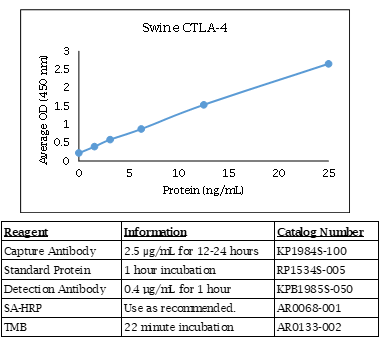
Swine CTLA-4 ELISA
- Catalog Number:
- DIY1986S
- Availability:
- In stock
- Application:
- ELISA
- 100% Homology:
- Sus scrofa (pig)
 Powered by Bioz
 Components
| Usage | Quantity | Component | Size |
|---|---|---|---|
| Detection Antibody | 50 µg | KPB1985S-050 | |
| Standard | 5 µg | RP1534S-005 | |
| Capture Antibody | 100 µg | KP1984S-100 | 1 Pack (<= 10 Plates) |
| Capture Antibody | 100 µg x 2 | KP1984S-100 | 1 Pack (<= 20 Plates) |
- The Swine CTLA-4 (Cytotoxic T-Lymphocyte-Associated Protein 4, CD152) ELISA is designed for the quantitative measurement of CTLA-4 in porcine (swine) cell culture supernatants and can also be used to measure CTLA-4 in additional biological sample types reported in the literature, including serum, plasma, bronchoalveolar lavage (BAL) fluid, lymphoid tissue lysates, and other tissue homogenates, with minor protocol modifications recommended to optimize performance across different matrices. CTLA-4 is an immune checkpoint receptor expressed primarily on activated T lymphocytes and regulatory T cells, where it functions as a critical negative regulator of T cell activation by binding to CD80 and CD86 on antigen-presenting cells, thereby limiting CD28-mediated costimulatory signaling and maintaining immune homeostasis. In swine, CTLA-4 plays an important role in regulating adaptive immune responses, preventing excessive inflammation, and modulating immune tolerance during chronic infection and inflammatory disease. In healthy pigs, soluble CTLA-4 levels in circulation are typically low or near the limit of detection, but concentrations may increase during chronic infectious diseases such as porcine reproductive and respiratory syndrome virus (PRRSV), African swine fever virus (ASFV), porcine circovirus type 2 (PCV2), Mycoplasma hyopneumoniae infection, and enteric infections, as well as in tumor models and prolonged inflammatory conditions, depending on disease stage and immune status. In veterinary and translational research, swine CTLA-4 serves as an important biomarker of immune checkpoint activation, T cell exhaustion, chronic infection, immune regulation, and response to immunomodulatory therapies or vaccine strategies in porcine disease models. The ELISA kit contains a capture antibody, detection antibody, and recombinant swine CTLA-4 protein standard validated for use together in an ELISA format; kit components are not supplied in matched quantities and may be purchased separately. This product is for research use only, not for use in diagnostic or therapeutic procedures, and is manufactured in the USA.
| Storage Conditions | 2°C to 8°C or -20°C |
| Country Of Origin | USA |
Swine CTLA-4 (Cytotoxic T-Lymphocyte–Associated Protein 4, also known as CD152) is an immune checkpoint receptor belonging to the immunoglobulin superfamily that functions as a key negative regulator of T-cell activation in pigs (Sus scrofa). CTLA-4 is primarily expressed on activated CD4⁺ and CD8⁺ T lymphocytes and on regulatory T cells (Tregs) following antigen stimulation. It binds to the costimulatory ligands CD80 (B7-1) and CD86 (B7-2) on antigen-presenting cells such as dendritic cells, macrophages, and B cells, competing with the activating receptor CD28 for these ligands. Engagement of CTLA-4 transmits inhibitory signals that suppress T-cell proliferation, cytokine production, and immune activation, thereby helping maintain immune homeostasis and peripheral tolerance. In swine, CTLA-4 signaling is particularly relevant during viral infections such as porcine reproductive and respiratory syndrome virus (PRRSV), where excessive or dysregulated T-cell responses can influence disease outcome. Pigs are also used as large-animal models for transplantation immunology, and CTLA-4–Ig fusion proteins (similar to the human therapeutic abatacept/belatacept) have been tested in pig-to-nonhuman primate xenotransplantation studies, where blockade of CD28-mediated costimulation through the CTLA-4 pathway helps reduce T-cell–mediated graft rejection. These studies make swine CTLA-4 an important component of translational research on immune checkpoint regulation and tolerance induction in transplantation and immunotherapy.
Citations
Please choose a size to see price
RELATED MEDIA
