Slide 1 of 1 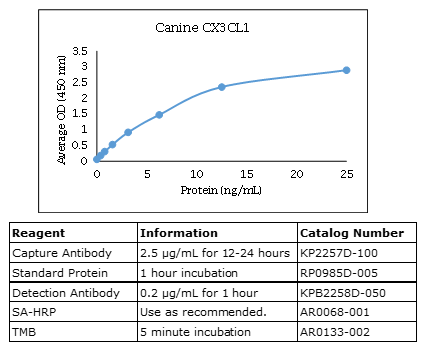
Canine CX3CL1 (Fractalkine) ELISA
- Catalog Number:
- DIY2259D
- Availability:
- In stock
- Application:
- ELISA
- 100% Homology:
- Canis lupus dingo (dingo), Canis lupus familiaris (dog)
 Powered by Bioz
 Components
| Usage | Quantity | Component | Size |
|---|---|---|---|
| Detection Antibody | 50 µg | KPB2258D-050 | |
| Standard | 5 µg | RP0985D-005 | |
| Capture Antibody | 100 µg | KP2257D-100 | 1 Pack (<= 10 Plates) |
| Capture Antibody | 100 µg X 2 | KP2257D-100 | 1 Pack (<= 20 Plates) |
- The Canine CX3CL1 (C-X3-C motif chemokine ligand 1, also known as Fractalkine) ELISA is designed for the quantitative measurement of CX3CL1 in dog (Canis lupus familiaris) cell culture supernatants and can also be used to measure CX3CL1 in additional biological sample types reported in the literature, including serum, plasma, cerebrospinal fluid (CSF), synovial fluid, bronchoalveolar lavage (BAL) fluid, and tissue lysates, with minor protocol modifications recommended to optimize performance across different matrices. CX3CL1 is a unique chemokine that exists in both membrane-bound and soluble forms and is produced primarily by endothelial cells, epithelial cells, neurons, and activated macrophages in response to inflammatory stimuli. It functions through the CX3CR1 receptor to mediate firm adhesion and chemotaxis of monocytes, T lymphocytes, NK cells, and microglia, thereby linking vascular activation with leukocyte recruitment. In healthy dogs, circulating CX3CL1 levels are typically low or near the limit of detection, but concentrations may increase during inflammatory, cardiovascular, neurologic, and immune-mediated diseases, depending on disease severity and tissue involvement. In veterinary and comparative medicine research, canine CX3CL1 is particularly relevant in naturally occurring disease models such as osteoarthritis, intervertebral disc disease, degenerative myelopathy, chronic kidney disease, dilated cardiomyopathy, and various cancers including lymphoma and melanoma, which parallel human inflammatory and neurodegenerative disorders. Measurement of canine CX3CL1 provides valuable insight into monocyte and lymphocyte trafficking, neuroinflammation, vascular inflammation, and tumor-associated immune responses in both veterinary and translational research settings. The ELISA kit contains a capture antibody, detection antibody, and recombinant canine CX3CL1 protein standard validated for use together in an ELISA format; kit components are not supplied in matched quantities and may be purchased separately. This product is for research use only, not for use in diagnostic or therapeutic procedures, and is manufactured in the USA.
| Storage Conditions | 2°C to 8°C or -20°C |
| Country Of Origin | USA |
Canine CX3CL1 (C-X3-C motif chemokine ligand 1), also known as fractalkine, is a chemokine belonging to the CX3C chemokine family, characterized by three amino acids separating the first two conserved cysteine residues. CX3CL1 is unique among chemokines because it exists in both a membrane-bound form and a soluble form, allowing it to function in both leukocyte adhesion and chemotaxis. In dogs (Canis lupus familiaris), CX3CL1 is produced primarily by endothelial cells, epithelial cells, neurons, and macrophages in response to infection, inflammatory cytokines, or tissue injury. CX3CL1 binds to its receptor CX3CR1, which is expressed on monocytes, macrophages, natural killer (NK) cells, and subsets of T lymphocytes, promoting adhesion, migration, and activation of these immune cells at sites of inflammation. In canine health, CX3CL1 contributes to immune responses in inflammatory diseases, infectious conditions, and tissue injury, particularly in the central nervous system and cardiovascular tissues where fractalkine signaling regulates leukocyte–endothelial interactions. Dogs also serve as comparative animal models for human inflammatory and neurological diseases, and the CX3CL1–CX3CR1 pathway has been studied in canine models of neuroinflammation and spinal cord injury, where fractalkine signaling influences microglial activation and immune cell recruitment in damaged neural tissue. These studies help improve understanding of chemokine-mediated neuroimmune interactions and inflammatory mechanisms relevant to both veterinary medicine and human neurological disease research.
Citations
Please choose a size to see price