Slide 1 of 1 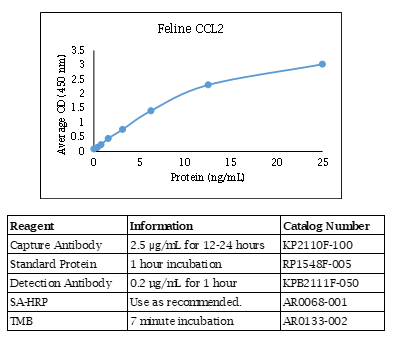
Feline CCL2 (MCP-1) ELISA
- Catalog Number:
- DIY2118F
- Application:
- ELISA
- 100% Homology:
- Acinonyx jubatus (cheetah), Felis catus (domestic cat), Puma concolor (puma)
 Powered by Bioz
 Components
| Usage | Quantity | Component | Size |
|---|---|---|---|
| Detection Antibody | 50 µg | KPB2111F-050 | |
| Standard | 5 µg | RP1548F-005 | |
| Capture Antibody | 100 µg | KP2110F-100 | 1 Pack (<= 10 Plates) |
| Capture Antibody | 100 µg X 2 | KP2110F-100 | 1 Pack (<= 20 Plates) |
- The Feline CCL2 (C-C motif chemokine ligand 2, also known as MCP-1) ELISA is designed for the quantitative measurement of CCL2 in cat (Felis catus) cell culture supernatants and can also be used to measure CCL2 in additional biological sample types reported in the literature, including serum, plasma, cerebrospinal fluid (CSF), bronchoalveolar lavage (BAL) fluid, synovial fluid, urine, and tissue lysates, with minor protocol modifications recommended to optimize performance across different matrices. The feline CCL2 protein sequence is identical to that of Puma concolor (puma) and Acinonyx jubatus (cheetah), enabling this assay to be used for accurate detection across these closely related felid species. CCL2 is a pro-inflammatory CC chemokine produced primarily by monocytes, macrophages, endothelial cells, fibroblasts, and epithelial cells in response to inflammatory cytokines, infection, and tissue injury, and it functions through the CCR2 receptor to recruit monocytes, memory T cells, and dendritic cells to sites of inflammation. In healthy cats and related felids, circulating CCL2 levels are typically low or near the limit of detection, but concentrations can increase during inflammatory and infectious diseases such as feline infectious peritonitis (FIP), feline immunodeficiency virus (FIV) infection, feline leukemia virus (FeLV) infection, chronic kidney disease, inflammatory bowel disease (IBD), asthma, and neoplastic conditions including lymphoma and mammary carcinoma, depending on disease severity and timing of sampling. Measurement of feline CCL2 provides valuable insight into monocyte recruitment, chronic inflammation, immune-mediated pathology, tumor-associated immune responses, and disease progression in veterinary, wildlife, and translational research settings. The ELISA kit contains a capture antibody, detection antibody, and recombinant feline CCL2 protein standard validated for use together in an ELISA format; kit components are not supplied in matched quantities and may be purchased separately. This product is for research use only, not for use in diagnostic or therapeutic procedures, and is manufactured in the USA.
| Storage Conditions | 2°C to 8°C or -20°C |
| Country Of Origin | USA |
Feline CCL2 (C-C motif chemokine ligand 2, also known as monocyte chemoattractant protein-1, MCP-1) is a pro-inflammatory chemokine that plays a key role in recruitment and activation of monocytes, macrophages, and memory T cells during immune responses in cats (Felis catus). CCL2 signals primarily through the CCR2 receptor, activating downstream pathways that promote leukocyte migration, cytokine production, and coordination of innate and adaptive immune responses at sites of infection or tissue injury. In feline health, CCL2 is particularly relevant in inflammatory and infectious diseases such as feline infectious peritonitis (FIP) caused by feline coronavirus, feline immunodeficiency virus (FIV) infection, chronic kidney disease, and inflammatory bowel disease, where elevated CCL2 expression contributes to macrophage recruitment and local inflammatory pathology. While CCL2-mediated immune cell trafficking is essential for pathogen defense and tissue repair, dysregulated or excessive expression can drive chronic inflammation and immune-mediated tissue damage. As a biomarker of monocyte/macrophage recruitment and inflammatory activation, feline CCL2 is widely studied in investigations of host–pathogen interactions, immune regulation, and disease pathogenesis. Characterization of feline CCL2 supports veterinary research into inflammatory disease mechanisms and provides comparative insight into chemokine-driven immune responses relevant to human infectious and inflammatory disorders.
- Atherosclerosis
- Obesity
- Rheumatoid Arthritis
- Chemokine
- inflammation
- metabolism
Citations
Please choose a size to see price